Personality Types: The Complete Guide to MBTI, Big Five, and Self-Discovery
Explore personality types, MBTI, Big Five, cognitive biases, and accurate self-perception. Your essential guide to understanding yourself and others.


Estimated reading time: 15 min
Key Takeaways
- Understand the 16 MBTI personality types and Big Five traits for deeper self-awareness, including detailed cognitive function dynamics and trait nuances.
- Learn how cognitive biases distort your self-perception, with concrete examples and techniques to recognize and counteract them.
- Explore the nature vs nurture debate with twin and adoption study insights, and how genetics and environment interact to shape personality.
- Discover the accuracy and limitations of popular personality tests, including test-retest reliability, validity, and common misconceptions.
- Use insights from friends’ anonymous feedback with Blindspot to uncover your blind spots through real-world application and data-driven feedback loops.
Table of Contents
- Section 1: Introduction to Personality Types and Frameworks
- Section 2: MBTI Explained — The 16 Personality Types and Their Families
- Section 3: The Big Five Personality Traits — A Scientific Perspective
- Section 4: Common Cognitive Biases About Yourself and Their Effects
- Section 5: Personality Test Accuracy — What You Should Know
- Section 6: Nature vs Nurture in Personality Development
- Section 7: Applying Personality Insights to Your Life and Relationships
- Personality types are structured classifications that describe consistent patterns in how individuals think, feel, and behave across different situations. These types help encapsulate complex human behaviors into understandable categories, enabling better self-knowledge and empathy toward others. Unlike simplistic labels, these frameworks rely on observed tendencies that remain relatively stable over time but allow for individual nuances. For example, someone classified as an INFJ in MBTI may consistently prefer reflection and deep empathy but can behave differently depending on context, mood, or personal growth.
- Personality frameworks serve a variety of practical functions:
- Self-discovery: By identifying your natural tendencies, such as whether you recharge through solitude or socializing, you gain clarity on optimal environments and behaviors that align with your authentic self.
- Interpersonal understanding: Recognizing others' personality styles helps in decoding communication preferences, conflict triggers, and motivations, fostering stronger, more empathetic relationships.
- Career guidance: Matching your personality traits with suitable roles improves job satisfaction and performance. For instance, high conscientiousness aligns well with detail-oriented professions, while high openness supports creative fields.
- Personal growth: Frameworks illuminate blind spots—traits or habits we might overlook or misunderstand—providing a roadmap for targeted development.
- The two most widely recognized and studied personality frameworks are:
- MBTI (Myers-Briggs Type Indicator): Categorizes individuals into 16 personality types based on preferences in four dichotomies. It emphasizes cognitive functions and psychological preferences rather than traits.
- Big Five Personality Traits: A trait-based model identifying five broad dimensions that reliably capture personality variation across cultures, supported by extensive empirical research.
- Both offer valuable but distinct insights: MBTI focuses on how people process information and make decisions, while Big Five measures stable trait expressions. When used together, they provide a richer, multi-layered understanding of personality.
- For a comprehensive exploration, check out our detailed guide on What Personality Type Am I?
- The MBTI framework is grounded in four dichotomous preference pairs, reflecting where individuals focus their attention and how they make decisions. Each pair represents a spectrum rather than absolutes, with most people leaning toward one side but capable of functioning in both:
- Extraversion (E) vs Introversion (I): This dimension indicates the source of energy. Extraverts recharge through interaction with the external world and tend to be outgoing and expressive, whereas introverts gain energy from internal reflection and often prefer solitary activities. For example, an Extravert may feel energized after a lively social gathering, while an Introvert might find the same event draining.
- Sensing (S) vs Intuition (N): This pair describes how people gather information. Sensors focus on concrete, present realities and detail-oriented facts, while Intuitives look for patterns, possibilities, and abstract relationships. An S-type might excel in tasks requiring attention to detail, such as accounting, while an N-type might enjoy conceptual brainstorming.
- Thinking (T) vs Feeling (F): This dichotomy relates to decision-making processes. Thinkers prioritize objective logic and principles, often valuing fairness and consistency; Feelers emphasize personal values and the impact on others, prioritizing harmony and empathy. For instance, a Thinking type might focus on data in a business decision, whereas a Feeling type might consider employee morale.
- Judging (J) vs Perceiving (P): This dimension reflects lifestyle orientation. Judging types prefer structure, planning, and decisiveness, often completing tasks ahead of deadlines. Perceiving types favor flexibility, spontaneity, and keeping options open, adapting easily to new information. For example, a Judging person might schedule their day meticulously, while a Perceiving person may improvise as events unfold.
- By combining these four dichotomies, MBTI defines 16 distinct personality types, each presenting characteristic behaviors, strengths, and challenges. Here are expanded profiles of select types to illustrate their depth:
- INTJ (The Architect): Known for strategic thinking and long-term vision, INTJs excel in planning complex projects and solving problems analytically. They often prefer working independently and may find emotional expression challenging, necessitating conscious effort to connect with others emotionally.
- ESFP (The Entertainer): Spontaneous and charismatic, ESFPs thrive in social environments, bringing energy and enthusiasm. Their preference for action sometimes leads to impulsive decisions. Developing foresight and patience can enhance their effectiveness.
- INFJ (The Advocate): Deeply empathetic and insightful, INFJs are driven by ideals and a desire to help others. They tend to be reserved and private, often keeping their true feelings hidden. Cultivating openness can improve their interpersonal relationships.
- ESTJ (The Executive): Organized and practical, ESTJs are natural leaders who value order and efficiency. Their direct communication style can sometimes be perceived as rigid or insensitive, so developing flexibility and emotional awareness is beneficial.
- MBTI types cluster into four families with shared dominant cognitive functions and temperaments, providing an additional layer of understanding:
- Analysts (NT types): Innovative, logical, and strategic thinkers who enjoy problem-solving and theoretical challenges. Examples include INTJ and ENTP. They often prioritize competence and knowledge over social harmony.
- Diplomats (NF types): Empathetic, idealistic, and cooperative, NFs focus on personal growth and social causes. INFJ and ENFP exemplify this group. They value authenticity and meaningful connections.
- Sentinels (SJ types): Responsible, organized, and practical, SJs maintain traditions and uphold social order. ESTJ and ISFJ are key types here. They often excel in administrative or caregiving roles.
- Explorers (SP types): Adventurous, adaptable, and action-oriented, SPs seek excitement and hands-on experiences. ESFP and ISTP typify this family. They thrive in dynamic environments requiring quick thinking.
- Each family shares cognitive function hierarchies that influence processing styles. For instance, Analysts lead with Introverted Intuition or Extraverted Intuition, shaping their preference for abstract thinking. Understanding these nuances aids in appreciating the complexity behind type labels.
- For a full exploration of MBTI types, their cognitive functions, and how to leverage this knowledge for self-discovery, visit our comprehensive MBTI Explained guide.
- The Big Five model, also known as the Five Factor Model (FFM), identifies five broad dimensions that capture the majority of human personality variation. Each trait exists on a continuum, with individuals scoring anywhere along the spectrum. These traits are:
- Openness to Experience: Reflects imagination, curiosity, and openness to new ideas. High scorers tend to be creative, appreciate art, and enjoy intellectual exploration; low scorers prefer routine and conventionality.
- Conscientiousness: Indicates self-discipline, organization, and goal-directed behavior. High conscientiousness predicts reliability and strong work ethic, while low levels may associate with impulsivity and disorganization.
- Extraversion: Captures sociability, assertiveness, and positive emotionality. Extroverts enjoy social interaction and stimulation; introverts prefer solitude and are more reserved.
- Agreeableness: Measures compassion, cooperativeness, and trustworthiness. High agreeableness aligns with kindness and empathy, whereas low agreeableness may manifest as skepticism or competitiveness.
- Neuroticism: Reflects emotional stability versus tendency toward anxiety, moodiness, and vulnerability. High neuroticism often indicates emotional reactivity and stress sensitivity.
- The Big Five model is esteemed for several reasons:
- Empirical foundation: It emerged from rigorous factor analyses of language and trait descriptors across diverse populations, demonstrating cross-cultural robustness.
- Predictive power: Big Five traits consistently correlate with important life outcomes, such as job performance, relationship satisfaction, and mental health.
- Stability over time: While some traits can shift slightly due to life experiences, the Big Five dimensions show relative stability from adolescence onward.
- For example, conscientiousness is one of the strongest predictors of academic and occupational success, with studies showing correlations upwards of r = 0.30 to 0.50 in meta-analyses. Neuroticism is strongly linked to risk for anxiety and mood disorders.
- Each trait relates to distinct facets of life and provides actionable insights:
- Career fit: High conscientiousness individuals excel in roles requiring diligence, such as accounting, law, and project management. High openness supports creative professions like writing, design, and research. Extraverts may thrive in sales and leadership, while introverts often succeed in analytical or technical roles.
- Relationships: Agreeableness predicts cooperative behavior, conflict resolution skills, and overall relationship satisfaction. High neuroticism can increase susceptibility to relationship stress and conflicts.
- Health and well-being: Extraversion is associated with greater social support and positive affect, which buffer against stress. Conversely, high neuroticism correlates with poorer health outcomes due to stress sensitivity.
- Understanding your Big Five profile can guide targeted personal development. For example, someone high in neuroticism might benefit from mindfulness practices and stress management, while a low conscientiousness individual could implement structured routines to enhance productivity.
- For an in-depth exploration of these traits and their applications, see our post on Discovering Hidden Personality Traits.
- Our brains employ shortcuts to process vast information efficiently, but these heuristics can lead to systematic distortions known as cognitive biases. When applied to self-perception, these biases create blind spots, inaccurate self-assessments, and misinterpretations of our behavior. Some key biases include:
- Self-serving bias: The tendency to attribute successes to internal qualities (e.g., skill, effort) and failures to external factors (e.g., luck, others’ mistakes). This preserves self-esteem but hinders objective self-evaluation. For example, believing you passed a test solely due to intelligence while blaming a poor grade on unfair questions.
- Confirmation bias: Selectively attending to information that aligns with your existing self-image while disregarding contradicting evidence. If you view yourself as punctual, you may overlook times you were late or justify those instances.
- False consensus effect: Overestimating how much your beliefs, values, or behaviors are shared by others. This can lead to assuming your personality traits are universal or typical when they might be unique.
- Impostor syndrome: Despite evidence of competence, individuals discount their achievements and fear being exposed as a fraud, which distorts self-perception negatively.
- Spotlight effect: Overestimating how much others notice your mistakes or flaws, leading to undue self-consciousness.
- Awareness of these biases is critical for developing accurate self-knowledge and improving interpersonal interactions. Benefits include:
- Bridging gaps between self-perception and others’ views, which reduces misunderstandings and fosters empathy.
- Encouraging openness to feedback, which is essential for growth and skill development.
- Enhancing decision-making by grounding choices in realistic self-appraisal rather than distorted beliefs.
- Improving emotional regulation by recognizing when cognitive distortions fuel anxiety or low self-esteem.
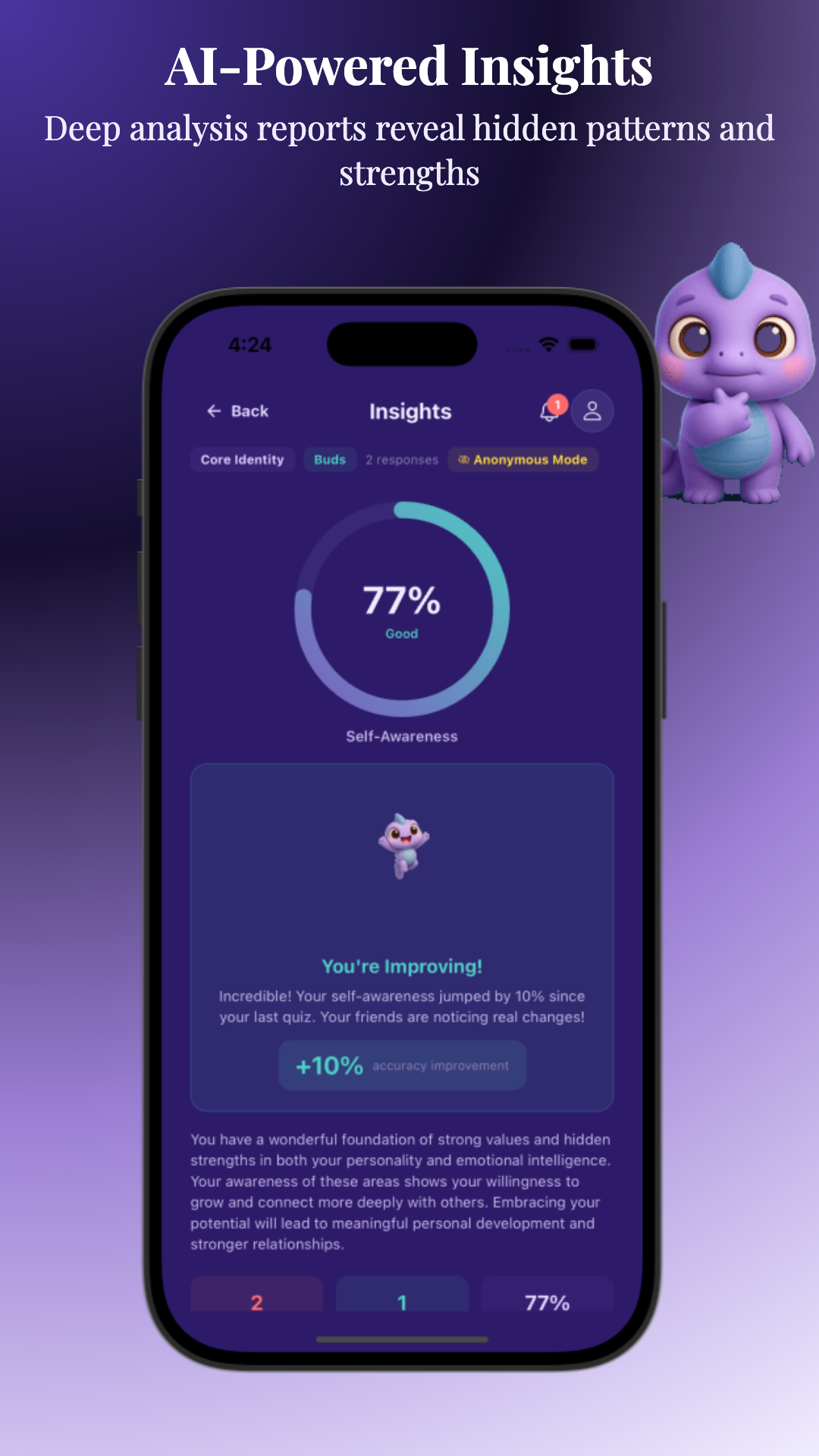
- Blindspot is a powerful tool designed to bridge the gap between your self-view and how others perceive you. By anonymously collecting feedback from friends across multiple personality dimensions, Blindspot highlights discrepancies that you might be unaware of, effectively illuminating cognitive biases in action.
- For example, if you rate yourself as highly organized but multiple friends note inconsistencies in your follow-through, this feedback reveals a blind spot shaped by self-serving or confirmation biases. Such insights empower you to recalibrate your self-image and target specific behaviors for improvement.
- The platform’s data visualization makes these differences clear and actionable, showing you not just what your blind spots are but also trends over time as you work on them.
- For a deeper understanding of these psychological phenomena, see our Cognitive Biases About Yourself guide.
- The reliability and validity of personality assessments vary greatly depending on their scientific grounding and methodology. Key points include:
- Big Five tests: These are generally reliable and valid, with strong test-retest consistency (correlations often above 0.80 over weeks or months), meaning individuals tend to get similar scores when retesting under stable conditions.
- MBTI: Faces criticism for limited predictive validity and inconsistent results upon retesting; some studies report test-retest reliability as low as 0.50 to 0.60, indicating fluctuating type assignments.
- Non-standardized tests: Many online quizzes lack rigorous construction, leading to inaccurate or overly generalized results.
- Test design: Validated instruments use well-constructed items and scoring algorithms that minimize bias and maximize clarity.
- Honesty in responses: Social desirability bias can lead respondents to answer in ways that seem favorable rather than truthful, skewing results. Anonymous or confidential formats improve honesty.
- Context and mood: Temporary emotional states or situational factors can influence answers. For example, stress might increase neuroticism scores temporarily.
- Self-awareness: Individuals with higher self-knowledge tend to provide more accurate assessments.
- Personality assessments should be used as tools for self-reflection, not definitive labels. Consider the following when interpreting results:
- View results as probabilistic tendencies rather than fixed categories.
- Combine test outcomes with real-world feedback from trusted friends or colleagues to cross-validate findings.
- Use scores to identify potential growth areas rather than as limitations.
- Reassess periodically, considering changes in life circumstances and personal development.
- Blindspot’s anonymous survey approach complements testing by providing multi-rater feedback, enhancing accuracy through social validation. This triangulation helps overcome individual biases and offers a more holistic personality portrait.
- Learn more about test validity and common myths in our detailed post Personality Test Accuracy: Science, Myths, and Self-Perception.
- Personality emerges from a complex interplay between genetic inheritance (nature) and environmental factors (nurture). Neither acts in isolation; rather, they interact dynamically across development. Contemporary psychology acknowledges this interdependence, moving beyond simplistic dichotomies.
- Twin studies: Research comparing identical twins raised apart versus together estimates heritability of personality traits between 40-60%. For example, extraversion and neuroticism show moderate genetic influence, suggesting biological underpinnings in temperament.
- Biological bases: Genetics affect brain structures, neurotransmitter systems, and hormonal regulation, influencing temperament dimensions such as emotional reactivity, impulsivity, and social behavior.
- Gene-environment interaction: Genetic predispositions can moderate responsiveness to environmental stimuli, whereby certain traits manifest only in conducive contexts.
- Family upbringing: Parenting styles, attachment experiences, and early life stress shape emotional regulation, social skills, and coping strategies.
- Culture: Societal norms influence expression and valuation of traits. For instance, collectivist cultures might emphasize agreeableness and conformity, while individualistic cultures prize openness and assertiveness.
- Education and socialization: Schooling, peer groups, and life experiences mold personality expression and skill development.
- Social feedback: Feedback from friends and significant others, such as via Blindspot, offers external perspectives that can reinforce or challenge self-concepts, facilitating growth and adjustment.
- Understanding this nuanced interaction helps explain why personalities evolve over time and vary even among genetically similar individuals.
- For a thorough comparison and current research, visit our detailed exploration at Nature vs Nurture Personality.
- Leveraging personality knowledge can significantly enhance career satisfaction and performance. Examples include:
- Analysts (NT types): Their strategic thinking and problem-solving skills suit careers in engineering, scientific research, software development, and strategic planning. For example, an INTJ architect might excel in systems design or project leadership.
- Diplomats (NF types): Their empathy and creativity align with counseling, education, social work, and artistic fields. An ENFP might find fulfillment as a teacher or creative director.
- Sentinels (SJ types): Their reliability and organizational skills fit well in healthcare, administration, law enforcement, and financial services. An ISFJ nurse or ESTJ manager often thrives in structured environments.
- Explorers (SP types): Their adaptability and hands-on approach suit emergency services, design, entrepreneurship, and performance arts. An ESFP performer or ISTP mechanic exemplifies this fit.
- Understanding your natural inclinations helps in choosing roles and workplace cultures where you are most likely to succeed and feel energized.
- Personality influences how individuals interact and communicate:
- Extraverts: Tend to express themselves openly, enjoy group activities, and process thoughts aloud. They may need partners who appreciate social engagement.
- Introverts: Prefer deeper, intimate conversations and reflective interactions. They may benefit from partners who respect their need for personal space.
- Thinkers: Value direct, logical discussions and may prioritize truth over tact. Effective communication involves recognizing their preference for clarity.
- Feelers: Prioritize empathy, emotional nuance, and harmony. Partners attuned to emotional cues enhance relationship satisfaction.
- Compatibility is multi-faceted and involves more than type matching. Complementary traits can create balance, such as an Introverted Thinker partnering with an Extraverted Feeler, promoting growth and mutual understanding.
- For deeper insights into relationship dynamics and communication, see our Personality Types & the Psychology of Who You Are page.
- Blindspot’s anonymous feedback mechanism allows you to access honest perspectives from your social circle, revealing personality traits and behaviors you might overlook. This external lens is invaluable for:
- Identifying blind spots that impede personal or professional growth.
- Receiving constructive feedback without social pressure or bias.
- Tracking changes over time as you apply insights and work on development goals.
- Enhancing self-awareness, which is a key predictor of emotional intelligence and interpersonal effectiveness.
- By integrating self-assessment with multi-rater input, Blindspot creates a comprehensive personality profile that empowers meaningful change.
- Experience the transformative power of honest feedback and start uncovering your blind spots today: Blindspot.
- Personality frameworks like MBTI and the Big Five provide complementary lenses through which to understand the intricate mosaic of human behavior. They offer practical guidance for self-awareness, career alignment, and relationship building. However, cognitive biases often cloud our self-perception, making external feedback essential for a balanced view.
- The nature versus nurture debate underscores that our personalities are neither solely inherited nor fully shaped by environment but emerge from their ongoing interaction. By combining scientifically validated tests with honest social feedback tools like Blindspot, you can more accurately identify your strengths and blind spots.
- This integrated approach not only deepens self-understanding but also lays the groundwork for intentional personal development, healthier relationships, and greater life satisfaction.
- Q: What are the 16 personality types?
- A: The 16 personality types originate from the MBTI framework, which classifies people based on preferences within four dichotomies: Extraversion/Introversion, Sensing/Intuition, Thinking/Feeling, and Judging/Perceiving. Each type combines these preferences to reflect characteristic patterns of thinking, feeling, and behaving.
- Q: Which personality type is the most common?
- A: Prevalence varies by population, but ISFJ (Introverted, Sensing, Feeling, Judging) is frequently reported as the most common type in many Western countries. ISFJs are known for being nurturing, responsible, practical, and loyal.
- Q: What is the rarest personality type?
- A: INFJ (Introverted, Intuitive, Feeling, Judging) is often cited as the rarest MBTI type, making up approximately 1-2% of the population. INFJs are characterized by deep insight, idealism, and a reserved nature.
- Q: What are the best career paths for each personality type?
- A: Career suitability depends on individual strengths and preferences. Analysts (NT types) excel in strategic and technical roles; Diplomats (NF types) thrive in social, educational, or creative professions; Sentinels (SJ types) prefer structured and service-oriented jobs; Explorers (SP types) enjoy dynamic, hands-on careers. Understanding your type helps tailor career choices aligned with your natural talents.
- Q: How do the MBTI letters E/I, S/N, T/F, and J/P work?
- A: Each letter represents a preference within a dichotomy: E (Extraversion) or I (Introversion) indicates your source of energy; S (Sensing) or N (Intuition) relates to how you gather information; T (Thinking) or F (Feeling) reflects your decision-making style; J (Judging) or P (Perceiving) describes your lifestyle approach. These four preferences combine to form your unique MBTI type.
- Q: Which personality types are most compatible in relationships?
- A: Compatibility depends on shared values, communication, and mutual understanding rather than just personality type. However, complementary types, such as an Introverted Thinker paired with an Extraverted Feeler, often balance each other well. Successful relationships emphasize open communication and respect beyond type labels.
FAQ
Conclusion
Leveraging Blindspot for Growth
Relationship and Communication Styles
Career and Work-fit by Personality Type
Section 7: Applying Personality Insights to Your Life and Relationships
Environmental Influences
Genetic Influences
The Debate Explained
Section 6: Nature vs Nurture in Personality Development
Interpreting Your Results Effectively
Factors Affecting Test Accuracy
How Reliable Are Personality Tests?
Section 5: Personality Test Accuracy — What You Should Know