Personality Test Accuracy: Science, Myths, and Self-Perception
Explore personality test accuracy: Big Five, MBTI, validity, biases, and how to use results for growth. Uncover blind spots with science-backed insight.
Estimated reading time: 14 min
Key Takeaways
- Personality test accuracy relies on scientific concepts: reliability, validity, and predictive power.
- The Big Five personality traits are the most scientifically validated framework; MBTI has popularity but less empirical support.
- Self-perception is shaped by cognitive biases and the gap between self-view and others’ feedback.
- Online tests vary widely in quality—free quizzes often lack scientific rigor compared to research-backed assessments.
- Understanding your results requires context, reflection, and honest feedback, not just labels or scores.
Table of Contents
- Section 1: Understanding Personality Test Accuracy
- Section 2: The Big Five Personality Traits – Gold Standard of Accuracy
- Section 3: MBTI Explained – Accuracy, Reliability, and Critiques
- Section 4: Cognitive Biases and the Nature vs Nurture Personality Debate
- Section 5: Validity, Reliability, and Construct Challenges
- Section 6: Reading and Using Personality Test Results Wisely
- Conclusion
- FAQ
Section 1: Understanding Personality Test Accuracy
Scientific Foundations: Reliability and Validity
Personality test accuracy is rooted in two core scientific concepts: reliability (consistency of results) and validity (whether a test measures what it claims to measure). A test with high reliability produces similar results over time (test-retest reliability). Validity ensures the test captures real, meaningful traits—rather than arbitrary categories or stereotypes.
- Reliability: If you take a test multiple times, do your scores stay stable? For example, if you score high in Conscientiousness today, do you get a similar score if you retake the test in a few weeks—assuming your circumstances haven't radically changed?
- Validity: Does the test actually measure personality as defined by psychological research? This means the test items must be carefully designed and tested to ensure they correspond to real-world behaviors and psychological constructs.
Predictive Power: Beyond Labels
Beyond reliability and validity, predictive power matters: can your test results actually forecast real-life behaviors, choices, or outcomes? For example, do high conscientiousness scores predict job performance or academic success? The best personality frameworks have evidence showing that their results correlate with important life outcomes. For instance, research shows that high agreeableness is often linked to better teamwork and conflict resolution, while high extraversion can predict leadership emergence in group settings. Predictive power is what elevates a test from mere description to practical usefulness.
Common Uses—and Misuses—of Personality Testing
People use personality tests to answer questions like "what personality type am I?" or to improve relationships, career choices, and self-understanding. However, misuse is common: entertainment quizzes, vague categories, and tests that lack scientific support abound online. These usually fail on reliability, validity, or both. For example, a BuzzFeed quiz telling you which fictional character you resemble may be fun, but it isn’t psychologically meaningful.
- Scientifically validated tests: Big Five, some research-grade MBTI derivatives, and select clinical assessments (e.g., MMPI in clinical psychology)
- Less validated or entertainment-focused tests: Most free online quizzes, BuzzFeed-style tests, and many viral social media quizzes
For a deeper dive into the science of self-perception, see What Is a Personality Blind Spot? Understanding the Gaps in Self-Perception.
Ultimately, personality test accuracy depends on the intent behind the tool. If you need serious self-insight or to inform important life decisions (like hiring or therapy), look for tests with published reliability and validity data. If you are just looking for entertainment, be mindful that the results may not reflect your true personality.
Section 2: The Big Five Personality Traits – Gold Standard of Accuracy
The Big Five/OCEAN Framework
The Big Five personality traits—also known as OCEAN (Openness, Conscientiousness, Extraversion, Agreeableness, Neuroticism)—represent the most widely studied and empirically supported model in personality psychology. Research across cultures, ages, and languages confirms that these five dimensions capture the broad structure of human personality. The Big Five does not classify people into "types" but instead measures where individuals fall on each of five trait continua.
- Openness: Creativity, curiosity, openness to new experiences (e.g., someone high in Openness may love travel and abstract art, while someone low may prefer routine and concrete facts)
- Conscientiousness: Organization, dependability, self-discipline (e.g., high scorers excel at planning and meeting deadlines)
- Extraversion: Sociability, assertiveness, energy (e.g., extraverts thrive in group settings; introverts may prefer solo activities)
- Agreeableness: Compassion, cooperation, trust (e.g., high scorers are empathetic and generous, low scorers may be more competitive or critical)
- Neuroticism: Emotional instability, tendency toward anxiety (e.g., high scorers may experience stress easily, while low scorers are more emotionally resilient)
Each trait operates on a spectrum. Most people fall somewhere in the middle, with only a minority at the extremes. This dimensional approach allows for nuanced self-understanding rather than the rigidity of fixed "types."
Why the Big Five Outperforms Other Tests
When it comes to personality test accuracy, the Big Five leads in:
- Test-retest reliability: Results remain stable over time, especially for adults. Studies show that Big Five scores are remarkably consistent over periods of years, though minor changes can occur with age or major life events.
- Construct validity: Each trait is measurable, distinct, and rooted in decades of research. The Big Five structure has been replicated in more than 50 cultures and languages, supporting its universal application.
- Predictive power: OCEAN scores correlate with life outcomes (career, health, relationships). For example, high Conscientiousness predicts academic and professional success, while high Neuroticism is a risk factor for mental health struggles.
Meta-analyses have found that Big Five traits can account for significant proportions of variance in factors like job performance, divorce rates, and even longevity (e.g., higher Conscientiousness correlates with healthier behaviors and longer life).
Big Five in Practice: Career, Relationships, and Growth
Because of its accuracy, the Big Five is favored in academic research, HR assessments, and clinical settings. It’s commonly used to:
- Guide career fit based on conscientiousness or extraversion levels (e.g., sales roles may suit high Extraversion, while research roles may favor high Openness)
- Support relationship counseling and team building (e.g., understanding agreeableness and emotional stability to improve communication and conflict resolution)
- Help individuals understand strengths and blind spots (e.g., recognizing high Neuroticism may motivate stress management efforts)
To see how your traits compare globally, apps like Blindspot offer anonymous feedback and data-driven insights. Some organizations even use Big Five-based assessments in hiring or leadership development, given their predictive validity.
Additionally, the Big Five framework is used in longitudinal studies to track personality changes over time. Research shows that while personality is relatively stable, traits like conscientiousness often increase slightly with age, while neuroticism may decrease as people mature.
Section 3: MBTI Explained – Accuracy, Reliability, and Critiques
MBTI Overview and Popularity
The Myers-Briggs Type Indicator (MBTI) is one of the most recognizable personality tests worldwide. It assigns you a four-letter type (e.g., INFP, ESTJ) based on preferences along four dichotomies: Extraversion/Introversion, Sensing/Intuition, Thinking/Feeling, and Judging/Perceiving. Many people use MBTI to answer "what personality type am I?" and for career and relationship advice. MBTI’s appeal lies in its simple, memorable categories, and its focus on strengths rather than pathology, making it a familiar tool in workplaces and personal development.
MBTI Accuracy: The Critiques
While MBTI is fun and relatable, scientific support for its accuracy is mixed:
- Test-retest reliability: Many people get different types on retaking the test weeks or months later. Estimates suggest that up to 50% of people may change "type" within a few weeks, raising concerns about the test’s stability.
- Construct validity: Critics argue that personality is not best described by binary categories or "types" but by spectrums (as in the Big Five). MBTI’s dichotomies (e.g., Extravert vs. Introvert) force people into one side, even if their preferences are moderate.
- Predictive power: MBTI types do not consistently predict job performance or other life outcomes. A 2018 review found little evidence that MBTI results correlate with job satisfaction, leadership capability, or relationship satisfaction.
Despite these issues, MBTI remains popular for team building and personal reflection, likely due to its simple, memorable categories and positive framing. It can help spark conversations and encourage self-reflection, but should be used with caution in high-stakes contexts such as hiring.
Some organizations supplement MBTI with more robust assessments or use MBTI primarily as a "starting point" for personal growth discussions rather than as a definitive guide.
MBTI vs. Big Five: Key Differences
- MBTI sorts people into 16 types; Big Five measures traits on continuous scales, allowing more nuance and capturing the full range of personality expressions.
- Big Five has more robust scientific backing, especially for reliability and validity, with decades of peer-reviewed research supporting its structure and implications.
- MBTI’s appeal is in its accessibility, but it’s less suited for serious decision-making. Big Five is preferred in academic and clinical contexts, as well as in scientific studies of personality development and prediction.
For more on how feedback and self-awareness tools work in practice, see What My Friends Think of Me Quiz: Reveal Your Blind Spots.
It’s also worth noting that some MBTI enthusiasts develop deep personal insights from their type descriptions, but the scientific consensus urges caution when applying MBTI results to major life choices—particularly career selection or therapy.
Section 4: Cognitive Biases and the Nature vs Nurture Personality Debate
How Cognitive Biases Distort Self-Perception
No personality test exists in a vacuum. Our self-understanding is shaped by a range of cognitive biases—systematic errors in how we see ourselves and interpret feedback. Examples include:
- Self-serving bias: Tendency to see ourselves in an overly positive light, such as rating ourselves as "above average" in honesty or intelligence, even when objective measures disagree.
- Confirmation bias: Seeking evidence that supports our pre-existing beliefs. For example, if you see yourself as an introvert, you may remember times you felt shy but ignore instances when you were outgoing.
- Blind spot bias: Recognizing biases in others but not ourselves, making it hard to accept feedback that contradicts our self-image.
These biases can cause gaps between our self-perception and how others see us—a core challenge Blindspot aims to reveal, helping users close their "blind spots" with honest, anonymized feedback from friends. For example, you might rate yourself as highly agreeable, but friends may see you as blunt or critical.
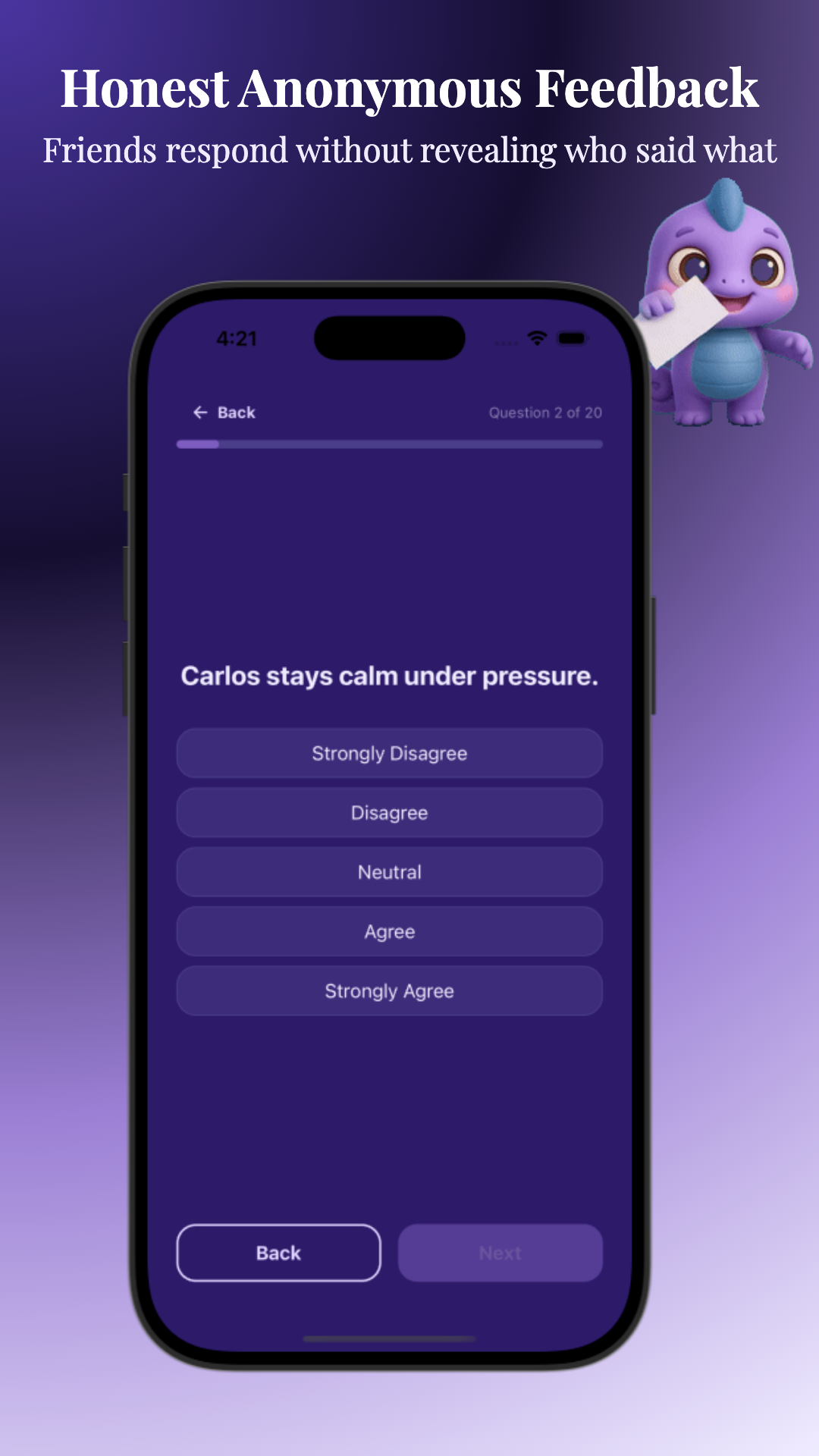
Recognizing these biases is the first step toward a more accurate self-understanding. Research shows that people who actively seek and reflect on feedback from others tend to have more realistic self-perceptions, which is linked to better decision-making and personal growth.
Nature vs Nurture: What Shapes Personality?
The classic "nature vs nurture personality" debate asks: Are we born with fixed personality traits, or do environment and experience shape who we are? Research shows it’s both:
- About 40-60% of personality is heritable (nature), as shown by twin and adoption studies which compare similarities between genetically identical and non-identical siblings raised together or apart.
- The remainder is influenced by life experiences, culture, and relationships (nurture). This includes factors like parenting style, major life events, education, and peer influences.
This means your scores on personality tests can be stable, but also shift over time—especially after major life events or with conscious self-development efforts. For example, significant trauma or a transformative experience (such as moving to a new country or starting a new career) can shift certain trait scores, particularly Openness or Neuroticism.
Longitudinal research supports the idea that while core personality traits are fairly stable, intentional interventions—such as therapy, mindfulness training, or goal-setting—can lead to measurable change, especially in traits like Conscientiousness and Emotional Stability.
Why Honest Feedback Matters
To counteract biases and get a more accurate sense of self, it’s essential to seek honest feedback from others. Tools based on the Johari Window, and apps like Blindspot, encourage you to examine your self-view alongside input from friends—turning blind spots into opportunities for growth. For practical steps, see How to Uncover Your Social Blind Spots: Step-by-Step Guide.
Honest feedback helps you identify patterns that may be invisible to you, such as recurring communication problems or misaligned intentions and perceptions. This multidimensional feedback is crucial for leadership development, conflict resolution, and even personal relationships.
Section 5: Validity, Reliability, and Construct Challenges
What Makes a Personality Test “Accurate”?
Three pillars determine personality test accuracy:
- Reliability: Consistency over time and across situations. For example, a high-quality test should give you similar results whether you take it now or next month, assuming no major life changes.
- Validity: The test measures real, scientifically recognized traits. This includes construct validity (are the traits real and distinct?), criterion validity (do scores predict real-world outcomes?), and face validity (do the questions make intuitive sense?).
- Norms and cross-cultural validation: The test works for different populations, not just where it was developed. For instance, the Big Five has shown strong results in both Western and non-Western countries, while some other frameworks have limited cross-cultural data.
The Big Five stands out because it meets these criteria globally. Tests like MBTI, Enneagram, and DISC often lack robust cross-cultural validation and are more susceptible to cultural bias or context effects. For example, the meaning of "Extraversion" may vary across cultures, so reliable tests calibrate their tools using local norms and translations.
Free Online Tests vs. Paid Assessments
- Free tests: Often shorter, less precise, and sometimes designed purely for entertainment; may lack evidence for their validity or reliability. For example, a 10-question quiz may not capture the complexity of personality, and results may fluctuate each time you take it.
- Research-grade/paid tests: Longer, carefully normed, and usually based on decades of psychological research (e.g., NEO-PI-R for Big Five). These tests often include validity scales to check for inconsistent or dishonest responses, and provide detailed feedback reports.
When choosing a test, ask: Is there published research? Are the questions transparent and clear? Does the test offer detailed feedback, or just a fun label? A well-designed paid assessment will often give you percentile rankings, compare your scores to large samples, and offer actionable insights for development.
Some reputable free tests are available from academic institutions or non-profit organizations, but they typically disclose limitations and encourage cautious interpretation. Paid versions, while not always necessary, may offer deeper analysis and more actionable recommendations, especially for professional development or therapy.
Construct Validity: Are the Traits Real?
Some frameworks—like the Big Five—have strong construct validity: their traits are observable, measurable, and repeatedly confirmed by research. Others, like the Enneagram and DISC, are popular but less scientifically grounded.
- Enneagram: Focuses on nine types and motivations; little scientific validation. While many find it insightful for personal exploration, scientific studies have found inconsistent results, and the framework lacks broad empirical support.
- DISC: Four behavioral styles; used in business, but not well-supported in academic psychology. DISC is often applied in corporate training, but research suggests its categories are too simplistic to capture the complexity of real personality traits.
For a methodical approach to self-insight, consider tools like the Johari Window Test, which blend feedback and self-report to reveal hidden aspects of personality.
The takeaway: use popular frameworks like Enneagram or DISC for inspiration and self-reflection, but lean on research-backed tools like the Big Five when accuracy and practical application matter.
Section 6: Reading and Using Personality Test Results Wisely
Interpreting Your Scores: Context Is Key
Whatever the framework—Big Five, MBTI, Enneagram—your personality test results are a starting point, not a verdict. Consider:
- Context: Were you stressed or distracted when taking the test? For example, answering after a difficult day may inflate your Neuroticism score. Consider retesting when you feel calm and focused for more consistent results.
- Honesty: Did you answer based on how you really are, or how you wish to be? Many people unconsciously answer in ways that reflect their aspirations or social desirability, which can skew results.
- Comparisons: Your score may mean different things in different cultures or settings. For instance, high assertiveness may be valued in one workplace but seen as aggressive in another.
It’s important to interpret your results as a guide to self-reflection, not as a rigid label. Use your scores to spark curiosity about your strengths and areas for growth, but avoid using them as excuses or as the sole basis for important decisions.
Growth, Feedback, and Blind Spots
Personality tests are most valuable when used alongside honest feedback. For example, Blindspot encourages you to invite friends to answer questions about you, revealing discrepancies between your self-view and others’ perceptions. This can help you identify social blind spots, challenge cognitive biases, and set realistic growth goals. For instance, you might see yourself as calm under pressure, but friends may point out moments when you appear anxious or reactive.
See how friends' input can shift your self-perception in How Friends Shape Our Self-Image: The Hidden Impact.
Regularly seeking feedback and reflecting on your results over time can help you track changes, set personal development goals, and improve your relationships. You can also use your scores to initiate conversations with mentors, coaches, or therapists for deeper exploration.
Best Uses for Personality Tests
- Career fit: Big Five is best for predicting workplace behavior and team roles. For example, high Conscientiousness is linked to reliability and leadership potential, while high Openness may indicate creativity and adaptability.
- Relationships: Use tests to spark dialogue, not to box people into types. Discussing differences in traits like Agreeableness or Extraversion can foster empathy and improve communication.
- Self-understanding: Let results guide reflection, not dictate identity. Use your scores as a starting point for exploring your habits, preferences, and growth areas.
To keep your growth journey grounded, revisit your scores periodically and seek regular feedback—especially from people who know you well. Document how your self-perceptions change over time and use that information to set new goals or adapt your strategies. Remember, personality is not destiny, and meaningful change is possible with self-awareness and effort.
Finally, beware of overinterpreting scores or using them as excuses. If you score high in Neuroticism, for example, it’s a cue to practice resilience—not a sentence to a lifetime of anxiety. Growth is about using insights for action, not self-limitation.
Conclusion
Personality test accuracy is more than just a score or label—it’s about scientific rigor, honest self-reflection, and the willingness to confront our blind spots. While frameworks like the Big Five offer reliable, valid insights, your results are only as useful as the honesty and context you bring to them. Combine self-assessment with feedback from others, and use tools like Blindspot to bridge the gap between who you think you are and how you’re seen. For deeper exploration, check out the 25 Insightful Questions to Ask Your Friends About Yourself and reflect on your journey toward self-awareness. If you want to explore the science behind personality frameworks and discover how MBTI and the Big Five compare, see our complete guide to MBTI, Big Five, and self-discovery.
FAQ
Q: What is the most accurate personality test?
A: The Big Five personality test (OCEAN) is considered the most accurate by psychologists for reliability, validity, and predictive power. It’s widely used in research and clinical settings.
Q: Are personality tests scientifically accurate?
A: Some are, but many aren’t. Tests like the Big Five are scientifically validated, while popular quizzes like the MBTI have less empirical support, and many online tests are just for fun.
Q: Is the MBTI accurate or reliable?
A: MBTI can be insightful for self-reflection, but it has low test-retest reliability and less scientific validity compared to trait-based models like the Big Five.
Q: Which personality test is best for career assessment?
A: The Big Five is preferred for career fit and workplace behavior, as its traits correlate strongly with job performance and team compatibility.
Q: How accurate is the Big Five personality test?
A: The Big Five offers high reliability and validity across cultures, with results that remain stable over time and predict important life outcomes.
Q: Are free personality tests trustworthy?
A: Free tests vary in quality. Some are based on valid frameworks but shorter and less precise; many are entertainment-focused and lack scientific backing. Use research-based tools for important decisions.