
Johari Window Online: The Complete Guide to Free Self-Discovery Tools
Discover the best Johari Window online platforms, how to use them for self-awareness, team growth, and practical tips for interpreting your results.


Estimated reading time: 14 min
Key Takeaways
- The Johari Window online test is a powerful tool for self-discovery and team development.
- It uses 56 classic adjectives to reveal differences between self-perception and others' views.
- Online Johari Window platforms make remote feedback and group exercises easy.
- Understanding your results can improve communication, leadership, and self-awareness.
- Modern tools like Blindspot bring the Johari Window into everyday self-growth and feedback cycles.
Table of Contents
- Section 1: The Origins and Purpose of the Johari Window
- Section 2: The Four Quadrants Explained
- Section 3: Taking a Johari Window Online Test
- Section 4: The 56 Classic Johari Adjectives and Selection Tips
- Section 5: Interpreting Your Johari Window Results
- Section 6: Using the Johari Window for Team Development
- Section 7: Virtual Collaboration Tools and Johari Window Exercises
- Section 8: Benefits, Pitfalls, and Best Practices
- Conclusion
- FAQ
Section 1: The Origins and Purpose of the Johari Window
1.1 The Birth of the Johari Window
The Johari Window was developed in the 1950s by psychologists Joseph Luft and Harrington Ingham. Their goal was to help people better understand their relationships with themselves and others, especially in group settings. The name "Johari" comes from a blend of their first names: Joseph and Harrington. Over seven decades later, this simple yet powerful framework remains a cornerstone in psychology, leadership training, and personal development.
1.2 Why Is the Johari Window So Useful?
Self-awareness is at the heart of personal and professional growth. The Johari Window is designed to:
- Reveal blind spots—traits known to others but hidden from ourselves.
- Uncover hidden strengths and weaknesses through peer feedback.
- Foster open communication and trust within teams.
- Provide a structured, non-confrontational way to receive honest feedback.
In recent years, the Johari Window test has become widely accessible online, making it easier than ever to use for remote teams and individual self-discovery.
1.3 The Johari Window in the Digital Age
With the rise of remote work and virtual collaboration, digital platforms have brought the Johari Window to a wider audience. Apps like Blindspot take the core principles—anonymous feedback, self-reflection, and personal growth—and make them interactive, engaging, and actionable. This digital evolution allows for more frequent, richer insights into how we see ourselves versus how others perceive us.
Section 2: The Four Quadrants Explained
2.1 The Structure of the Johari Window
The Johari Window is a simple 2x2 grid divided into four quadrants. Each area represents a different aspect of self-awareness and interpersonal knowledge:
- Open (Arena): Known to self and others.
- Blind Spot: Known to others, unknown to self.
- Hidden (Facade): Known to self, unknown to others.
- Unknown: Unknown to both self and others.
Understanding each quadrant is essential for interpreting your Johari Window online results and using them for growth.
2.2 Deep Dive Into Each Quadrant
- Open/Arena: Traits and behaviors you recognize in yourself, and others do too. This is the foundation of trust and effective teamwork.
- Blind Spot: Qualities others see in you, but you’re unaware of. Feedback here can be a game-changer for self-improvement.
- Hidden/Facade: Aspects you keep private, intentionally or not. Revealing more here often leads to deeper connections.
- Unknown: Latent qualities neither you nor others recognize yet—often revealed through new experiences or challenges.
2.3 Why the Quadrants Matter
The goal is to expand the Open quadrant, shrinking Blind Spots and Hidden areas. This leads to:
- Greater trust and transparency
- Better team performance
- Personal growth and self-awareness
For more on the psychology behind these quadrants, see Unlocking Self-Awareness Through Honest Feedback.
Section 3: Taking a Johari Window Online Test
3.1 How Does the Johari Window Online Test Work?
Online Johari Window tests translate the classic exercise into a digital format for individuals and teams. The typical process looks like this:
- Step 1: You select traits from a list of adjectives that describe yourself.
- Step 2: You invite friends, colleagues, or team members to select adjectives they associate with you.
- Step 3: The platform aggregates the responses and maps them onto the four quadrants.
- Step 4: You view the results, reflecting on the overlaps and discrepancies.
This process can be done asynchronously, making it ideal for remote teams or distributed friend groups.
3.2 Popular Free Online Johari Window Test Platforms
- Blindspot: Focuses on anonymous feedback, group creation, and AI-powered insights. Its homepage allows you to start instantly, track growth over time, and build custom groups.
- Classic JohariWindow.com: Offers a straightforward, free web-based Johari grid experience.
- Miro and Google Jamboard templates: Useful for teams wanting to collaborate visually, especially in workshops or retrospectives.
For a step-by-step walkthrough, check out the Johari Window Questionnaire: Unlock Self-Awareness Today.
3.3 Step-by-Step: Running a Johari Window Online Session
- Choose your platform (e.g., Blindspot or Miro).
- Select your group (coworkers, friends, or both).
- Share the test link and instructions—emphasize honesty and anonymity for best results.
- Review and discuss the results as a team or individually.
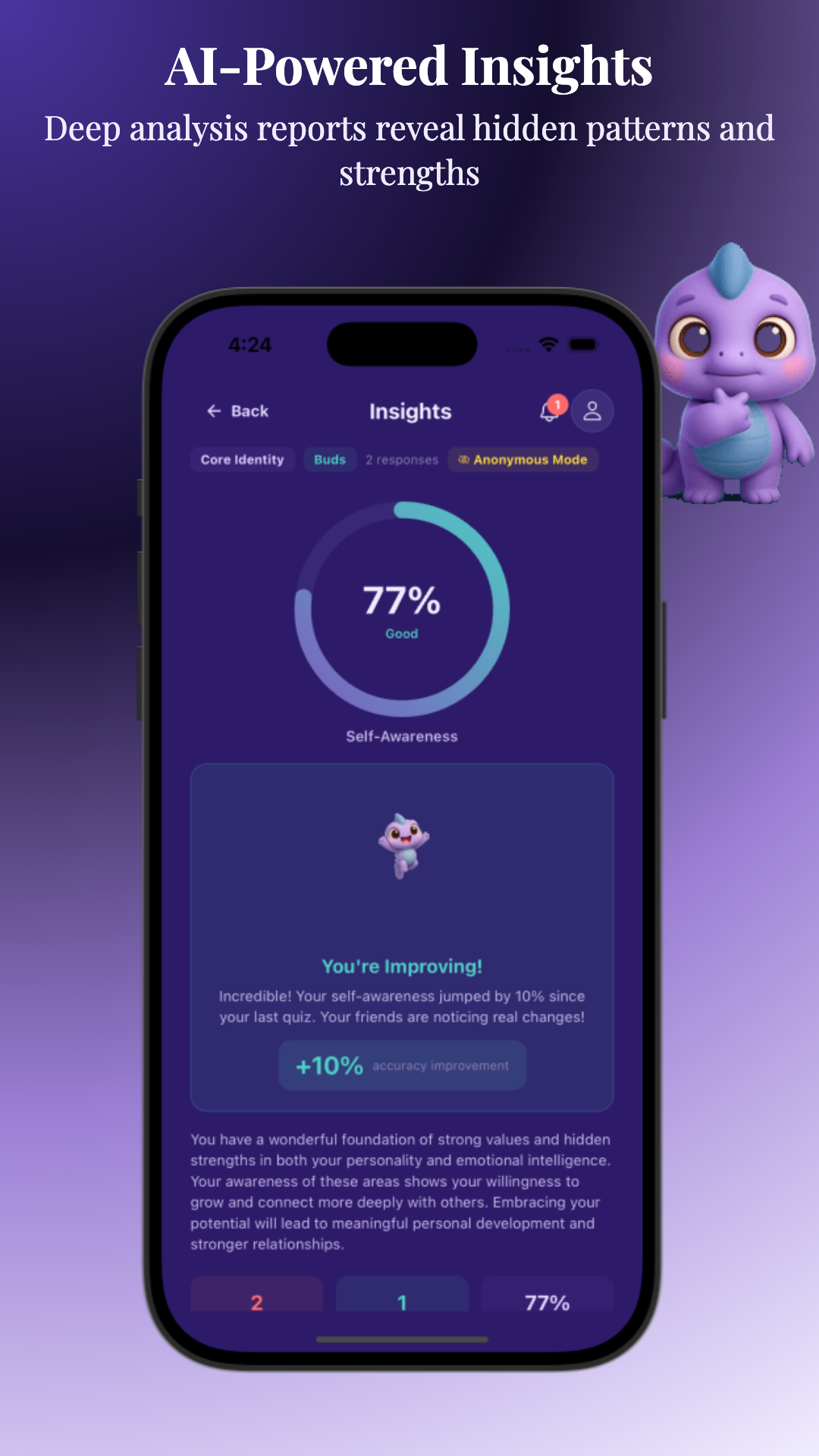
Here's an example of the feedback screen on Blindspot, where users receive actionable insights based on their results:
Section 4: The 56 Classic Johari Adjectives and Selection Tips
4.1 What Are the Johari Window Adjectives?
The core of the Johari Window test is its list of 56 adjectives. These descriptors were carefully chosen by Luft and Ingham to cover a wide range of personality traits, including strengths, weaknesses, and neutral characteristics. Some platforms may use a shorter list (usually 25-40), but the classic set captures the full spectrum of potential feedback.
4.2 The Complete List of 56 Johari Adjectives
- Accepting
- Adaptable
- Bold
- Brave
- Calm
- Caring
- Cheerful
- Clever
- Complex
- Confident
- Dependable
- Dignified
- Empathetic
- Energetic
- Extroverted
- Friendly
- Giving
- Helpful
- Idealistic
- Independent
- Ingenious
- Intelligent
- Introverted
- Kind
- Knowledgeable
- Logical
- Loving
- Mature
- Modest
- Nervous
- Observant
- Organized
- Patient
- Powerful
- Proud
- Quiet
- Rational
- Reflective
- Relaxed
- Religious
- Responsive
- Searching
- Self-assertive
- Self-conscious
- Sensible
- Sentimental
- Shy
- Simple
- Spontaneous
- Sympathetic
- Tense
- Trustworthy
- Warm
- Wise
- Witty
4.3 How to Select Adjectives Effectively
- Pick 5-6 words that truly resonate with how you see yourself.
- Encourage raters to be honest and to choose adjectives based on observed behavior, not wishful thinking.
- Avoid overthinking—first impressions are often the most accurate in this context.
- For team sessions, consider using an icebreaker to help everyone understand the adjectives before selecting.
For more guidance, see the detailed article: What My Friends Think of Me Quiz: Reveal Your Blind Spots.
Section 5: Interpreting Your Johari Window Results
5.1 Mapping Descriptors to Quadrants
Once all ratings are in, the adjectives are sorted into the four quadrants:
- Open: You and your raters both selected these traits.
- Blind Spot: Only your raters chose these words.
- Hidden: Only you selected these traits.
- Unknown: No one chose these adjectives.
The magic lies in the differences—your Blind Spot and Hidden areas offer the richest insights.
5.2 What Do the Results Mean?
- Large Open quadrant: High trust and alignment between self-perception and others’ views.
- Large Blind Spot: Opportunity for self-discovery—traits others see but you may not recognize.
- Large Hidden quadrant: You may be reserved or not fully authentic with others.
- Large Unknown area: Potential for growth and exploration. Try new roles or experiences to uncover these traits.
Apps like Blindspot make these distinctions visually clear, and offer contextual feedback and growth tracking.
5.3 Turning Insight Into Action
- Reflect on surprising results—why might others see you differently?
- Share your findings with a trusted peer or coach to gain deeper understanding.
- Set goals to expand your Open quadrant, either by seeking feedback or being more open with others.
- Review your results over time—growth is a continuous process.
For practical tips, read How to Uncover Your Social Blind Spots: Step-by-Step Guide.
Section 6: Using the Johari Window for Team Development
6.1 Why Teams Use the Johari Window
Organizations have long used the Johari Window as a tool for team building, leadership development, and performance improvement. Its simplicity makes it accessible to all, yet its depth provides powerful insights into group dynamics.
6.2 Team Exercise Guide
- Preparation: Choose an online platform and form groups of 4-8 people.
- Self-assessment: Each member completes their self-rating.
- Peer feedback: Everyone rates each other, ideally anonymously for honest results.
- Discussion: Meet virtually or in person to discuss surprising findings, blind spots, and new understandings.
- Action planning: Each person sets a personal or team goal based on their feedback.
For a more detailed team workshop outline, see the post Johari Window Questionnaire: Unlock Self-Awareness Today.
6.3 Leadership and the Johari Window
- Leaders can model vulnerability by sharing their own feedback and action steps.
- Teams can use the Johari Window to address communication issues and build psychological safety.
- Regular use helps teams adapt and grow together, especially in fast-changing environments.
Blindspot’s group feedback and progress tracking features are especially useful for ongoing team development.
Section 7: Virtual Collaboration Tools and Johari Window Exercises
7.1 Online Tools for Johari Window Exercises
- Blindspot: Anonymous surveys, group privacy options, and AI-powered insights make it easy to run Johari Window sessions remotely.
- Miro: Offers templates for real-time or asynchronous group feedback, using sticky notes in the four quadrants.
- Google Jamboard: Good for quick, collaborative sessions and visual mapping of traits.
- Dedicated Johari Window sites: Provide basic functionality for self/peer ratings and quadrant mapping.
7.2 Running a Virtual Johari Window Workshop
- Send out pre-work (self-assessment) before the meeting.
- During the session, have everyone enter peer feedback live or via a shared link.
- Use breakout rooms for small group discussion.
- Review group patterns and encourage open conversation about surprises and learnings.
- End with a round of action commitments.
Pairing the Johari Window with other feedback tools can create a richer development experience.
7.3 Example Exercise: Team Discussion Guide
- What surprised you about your Blind Spot quadrant?
- Are there traits in the Hidden quadrant you’d like to share more openly?
- How can our team help each other grow our Open areas?
- What’s one action you will take based on today’s feedback?
For more interactive exercises, see our guide on 25 Insightful Questions to Ask Your Friends About Yourself.
Section 8: Benefits, Pitfalls, and Best Practices
8.1 The Benefits of Johari Window Online
- Increased self-awareness: See yourself from multiple angles, not just your own lens.
- Improved communication: Break down barriers and encourage honest dialogue.
- Team trust: Shared vulnerability builds stronger connections.
- Personal growth: Actionable insights for lifelong development.
Online tools make it easy to revisit the process regularly, embedding feedback into your routine.
8.2 Common Pitfalls to Avoid
- Superficial feedback: Encourage raters to be specific and thoughtful.
- Taking results personally: Remember, feedback is a gift and a starting point for growth.
- Ignoring the Hidden quadrant: Sometimes the most valuable insights come from what you choose to hide.
- One-and-done mindset: The Johari Window is most powerful when used repeatedly.
8.3 Best Practices for Self-Discovery and Growth
- Be open and curious, not defensive.
- Share your findings with someone you trust.
- Set clear, small goals based on your results.
- Use apps like Blindspot to track progress and keep feedback loops alive.
- Regularly seek out new experiences to expand your Unknown quadrant.
For a deeper dive into why self-perception differs from others' views, see Why We See Ourselves Differently Than Others See Us.
Conclusion
The Johari Window online is more than just a personality quiz—it's a living framework that helps individuals and teams grow through honest feedback and self-reflection. Whether you're using classic web platforms or innovative apps like Blindspot, the process of uncovering your blind spots and hidden strengths is transformative. By understanding the four quadrants, using the 56 adjectives wisely, and making online feedback a regular habit, you'll boost your self-awareness, improve communication, and unlock your full potential.
Ready to discover yourself from new angles? Start your journey today with a Johari Window online test and invite your friends or team to join you.
FAQ
Q: What is the free online Johari Window test and how does it work?
A: The free online Johari Window test lets you select adjectives that describe yourself and invites others to do the same. The results are mapped into four quadrants (Open, Blind Spot, Hidden, Unknown) to reveal how your self-perception aligns or differs from others' views. Many platforms, like Blindspot, offer this process digitally for individuals and teams.
Q: How do I take the Johari Window test with my team online?
A: Choose an online platform (such as Blindspot or Miro), create a group, and have each member select adjectives for themselves and others. The software aggregates the feedback, displays the quadrants, and supports group discussion. Remote teams benefit from privacy options and real-time or asynchronous participation.
Q: What are the 4 quadrants of the Johari Window and what do they mean?
A: The four quadrants are Open (traits known to self and others), Blind Spot (known to others, not self), Hidden (known to self, not others), and Unknown (unknown to both). Each quadrant highlights a different area of self-awareness and communication.
Q: Which 56 adjectives are used in the Johari Window test?
A: The test uses 56 adjectives such as friendly, dependable, shy, witty, confident, and adaptable. These were designed to cover a broad range of personality traits. The full list is included above in Section 4.
Q: How can I interpret my Johari Window results to improve self-awareness?
A: Focus on traits in your Blind Spot (what others see, but you don't) and Hidden quadrants (what you know but keep private). Discuss surprising results with trusted peers and set small, actionable goals to expand your Open quadrant and reduce discrepancies.
Q: What are the best online tools or templates for doing the Johari Window exercise with a team?
A: Top tools include Blindspot (for anonymous, AI-powered feedback), Miro (for collaborative templates), and Google Jamboard (for visual mapping). Each supports group feedback, privacy, and remote participation.