Discovering Hidden Personality Traits: A Complete Framework Guide
Explore how to discover hidden personality traits with quizzes, frameworks like Big Five & MBTI, and self-awareness tools. Uncover your blind spots today.

Estimated reading time: 18 min
Key Takeaways
- Hidden personality traits are often unconscious, overlooked, or masked aspects of who we are.
- Personality frameworks—Big Five, MBTI, HEXACO, Enneagram—help reveal these blind spots.
- Quizzes, honest feedback, and self-reflection are essential for discovering hidden traits.
- Cognitive biases and stress responses impact how we perceive ourselves versus reality.
- Apps like Blindspot make self-discovery actionable by crowdsourcing honest feedback from friends.
Table of Contents
- Section 1: What Are Hidden Personality Traits?
- Section 2: Personality Frameworks for Revealing Blind Spots
- Section 3: The Power of Personality Quizzes and Assessments
- Section 4: Emotional Intelligence, Cognitive Biases, and Self-Perception
- Section 5: Coping Styles, Attachment, and Behavior Under Stress
- Section 6: Practical Methods to Discover Your Hidden Traits
- Conclusion
- FAQ
Section 1: What Are Hidden Personality Traits?
Defining Hidden Traits and Blind Spots
Hidden personality traits are aspects of your character, temperament, or behavior that are not immediately obvious to you—or sometimes even to others. These can be:
- Unconscious motivations or desires
- Suppressed impulses (the Jungian "shadow")
- Subtle tendencies that only show up in specific contexts or under pressure
- Qualities you underestimate or overestimate in yourself, due to cognitive biases
Blind spots can be positive (e.g., hidden strengths like resilience) or negative (e.g., a tendency to withdraw under stress). Discovering hidden personality traits is a key part of self-discovery and personal growth.
These hidden traits are often deeply rooted in our psyche, operating beneath conscious awareness. For example, you may consistently volunteer for group projects without realizing your innate leadership abilities, or you might find yourself procrastinating in certain situations due to a hidden fear of judgment or failure. These tendencies, once brought to light, can empower you to make more informed choices about your personal and professional life. Conversely, some traits may be masked due to societal expectations—such as men being discouraged from expressing vulnerability or women downplaying assertiveness—which can lead to significant aspects of one's personality remaining unexplored for years.
Why Do We Have Blind Spots?
There are several reasons why we aren’t fully aware of all aspects of our own personality:
- Cognitive biases skew our self-assessment (see Section 4)
- Social conditioning leads us to suppress certain traits
- Lack of feedback means we are rarely confronted with an outside perspective
- Nature vs nurture: Genetics and environment interact in complex ways, sometimes masking certain traits until triggered by life events
Blind spots are not static; they can change over time as we grow, experience new environments, and form new relationships. For instance, someone raised in a highly structured household may grow up believing they are naturally organized, only to discover in college or the workforce that they struggle with time management when external structures are removed. Similarly, a person who has always been the "quiet one" in their family may discover their extroverted side when traveling or living abroad, revealing a hidden comfort with social risk-taking.
Examples of Hidden Traits
Common examples include:
- Being more introverted or extroverted than you think (see Difference Between Introvert and Extrovert Personalities)
- Hidden anxieties or coping mechanisms that only appear under stress
- Unrealized leadership or empathy skills
- Impulses or biases you rationalize away
Consider the case of a high-performing professional who believes they thrive under pressure, but feedback from colleagues reveals a tendency to micromanage or display irritability during deadlines. Or, an individual who perceives themselves as conflict-averse may actually be highly assertive in defending their values, a trait that only emerges in heated discussions. Understanding these hidden layers is the first step in self-awareness. For a deeper dive into how psychological "blind spots" work, check out What Is a Personality Blind Spot?
Section 2: Personality Frameworks for Revealing Blind Spots
The Big Five Personality Traits
The Big Five model (OCEAN: Openness, Conscientiousness, Extraversion, Agreeableness, Neuroticism) is the gold standard in personality psychology. Each trait exists on a spectrum, revealing both strengths and potential blind spots. For example:
- Openness: Creativity vs. resistance to change
- Conscientiousness: Reliability vs. perfectionism or rigidity
- Extraversion: Sociability vs. impulsivity or dominance
- Agreeableness: Compassion vs. people-pleasing or passivity
- Neuroticism: Emotional awareness vs. anxiety or mood swings
Hidden traits often show up as "blind spots" within these dimensions. You might score high on conscientiousness but not realize how your perfectionism impacts others.
Let’s consider a practical example: If you rate yourself as highly agreeable, you may overlook your tendency to avoid necessary confrontations, which can lead to unresolved team conflicts. Conversely, if your extraversion is high, you might not recognize how your enthusiasm sometimes overwhelms quieter colleagues. By breaking personality down into these five domains, the Big Five provides a clear, quantifiable way to pinpoint strengths and weaknesses—some of which may be invisible without structured feedback.
MBTI Explained: What Personality Type Am I?
The Myers-Briggs Type Indicator (MBTI) sorts people into 16 types, based on four dichotomies:
- Introversion (I) vs. Extraversion (E)
- Sensing (S) vs. Intuition (N)
- Thinking (T) vs. Feeling (F)
- Judging (J) vs. Perceiving (P)
While MBTI is widely used, its accuracy is debated. Still, it offers a helpful lens for self-reflection, especially when compared to feedback from others. If you’ve ever wondered "what personality type am I?" MBTI can highlight areas you might overlook, such as hidden preferences in decision-making.
For example, someone who identifies as INFJ (Introverted, Intuitive, Feeling, Judging) may not be fully aware of how their preference for harmony influences their conflict avoidance, or how their intuition leads them to trust gut feelings over hard data. By reflecting on your MBTI type, you can uncover habitual patterns—like preferring routine (J) over spontaneity (P)—that may be holding you back in certain roles or relationships. Comparing your self-assessment with how friends or coworkers perceive you can also reveal discrepancies, prompting deeper self-examination.
Other Frameworks: HEXACO, Enneagram, and the Shadow
Other frameworks can further illuminate hidden traits:
- HEXACO: Adds "Honesty-Humility" to the Big Five, revealing hidden moral or ethical tendencies
- Enneagram: Explores core fears and motivations, surfacing unconscious drives
- Jungian Shadow: Focuses on suppressed or denied traits—the parts of ourselves we hide even from ourselves
Using multiple frameworks together provides a more complete map of your personality—and your blind spots.
The HEXACO model, for instance, might reveal a tendency towards modesty or manipulation that the Big Five overlooks. The Enneagram, with its nine archetypes, digs into motivations such as the need to be seen as successful (Type 3) or the desire for peace (Type 9), which can be surprisingly eye-opening when identified through honest self-assessment or peer feedback. The Jungian Shadow concept encourages you to explore the darker or less socially acceptable parts of your personality—like competitiveness, envy, or aggression—that, if unacknowledged, can drive behavior from the background. By applying two or more of these frameworks in tandem, you can triangulate your blind spots from different angles, increasing the chance that you'll discover hidden patterns or motivations you’ve never considered.
Section 3: The Power of Personality Quizzes and Assessments
Quiz-Style Assessments for Self-Discovery
Personality quizzes are popular for a reason: they provide a structured way to reflect and reveal patterns you might miss. The effectiveness of a quiz depends on:
- Its scientific foundation (Big Five-based quizzes are more reliable than "Which Dog Are You?")
- How honestly you answer (self-deception can cloud results)
- Whether you supplement self-assessment with outside feedback
For example, Blindspot’s quiz feature lets your friends anonymously answer questions about you, bridging the gap between self-perception and how others see you.
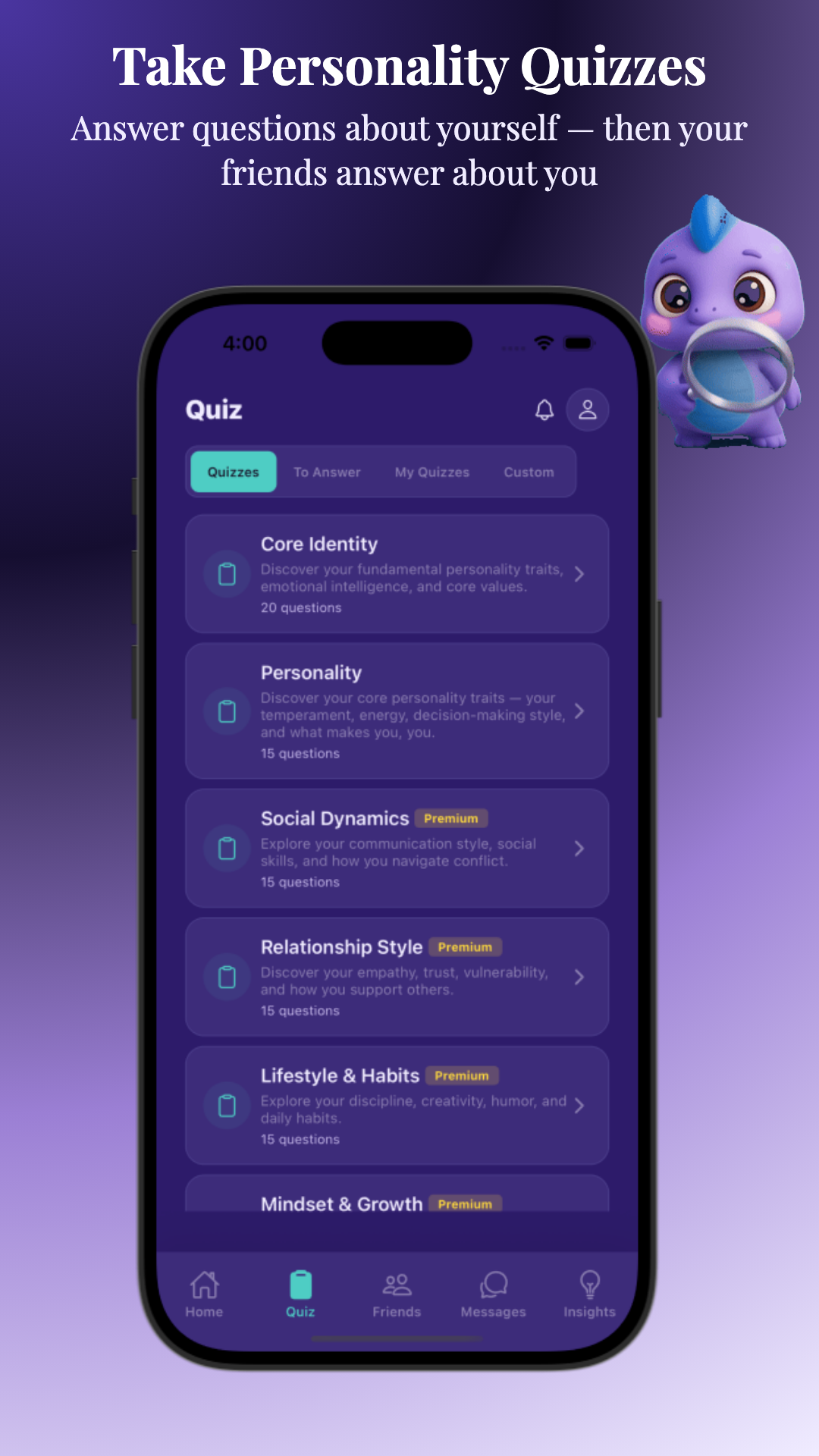
Quiz-style assessments come in many forms: online surveys, app-based tests, and interactive games. While some are just for fun, research shows that well-designed quizzes based on established models can reliably detect patterns across hundreds or thousands of respondents. For example, a Big Five quiz with 50+ questions can provide a nuanced personality profile that uncovers subtle tendencies, like a low tolerance for ambiguity or a predisposition toward skepticism. The key is to answer honestly, resisting the urge to select socially desirable responses. Blindspot enhances this process by inviting others to weigh in, which reduces self-serving bias and increases the accuracy of your results. The difference between how you see yourself and how others see you is often where your greatest blind spots lie.
Personality Test Accuracy: Can Tests Reveal Hidden Traits?
While no test is perfect, high-quality assessments can highlight hidden aspects of your personality—especially when combined with honest feedback. Accuracy improves when:
- Tests are based on validated frameworks (e.g., Big Five, HEXACO)
- You compare your self-view with others’ perspectives (360-degree feedback)
- You take multiple tests over time for consistency
Remember, tests can only reveal what you’re willing (or able) to see. That’s why blending self-assessment with peer feedback, like in What My Friends Think of Me Quiz, is so effective.
Consider the example of 360-degree feedback, a process commonly used in organizations, where supervisors, peers, and reports all rate your performance. This comprehensive approach is far more likely to expose hidden strengths (like an ability to mediate disputes) and weaknesses (such as a reluctance to delegate) than a self-report test alone. Similarly, taking personality assessments at different times—such as during calm periods and during stress—can reveal how your traits fluctuate in response to context. This layered approach to assessment increases reliability and enables deeper insights, especially when combined with anonymous peer reviews or structured feedback from trusted circles.
Popular Tests and Their Insights
- Big Five Inventory: Reliable, research-backed, highlights personality spectra
- MBTI: Useful for self-understanding, less predictive of behavior
- Johari Window Test: Reveals gaps between self-perception and others’ views (see Johari Window Test)
- Enneagram: Explores core motivations and potential blind spots
Using these quizzes as a starting point, you can dig deeper into the traits you—and others—may not fully recognize.
For example, the Big Five can help you realize you’re more open to new experiences than you thought, explaining your love of travel or art. The MBTI can clarify why you prefer solo work (Introversion) or why you’re energized by brainstorming sessions (Extraversion). The Johari Window is particularly effective for mapping "unknown unknowns"—traits neither you nor others recognize—using a two-way feedback process. The Enneagram can expose deeply rooted fears or drivers, such as the need to be needed (Type 2) or a compulsion for perfection (Type 1). Regularly revisiting these tests, and comparing results over time, can reveal shifts in your self-concept and help you track personal growth in a measurable way.
Section 4: Emotional Intelligence, Cognitive Biases, and Self-Perception
How Emotional Intelligence Exposes Hidden Traits
Emotional intelligence (EQ) is your ability to recognize, understand, and manage your own emotions—and those of others. High EQ isn’t just about empathy; it also involves self-awareness and the ability to spot your own blind spots. People with high EQ:
- Notice their reactions under stress
- Are open to feedback about their impact on others
- Recognize patterns in their thinking and behavior
Increasing your EQ can help uncover hidden personality traits—like defensiveness, impulsivity, or untapped strengths.
For instance, someone with high EQ may recognize that their irritation during a heated meeting is less about the topic and more about feeling unappreciated. This level of self-awareness allows them to address the root cause, rather than react defensively. Conversely, those with lower EQ may misattribute their emotional responses, blaming others or external circumstances and missing opportunities for self-growth. Practicing mindfulness, engaging in active listening, and intentionally seeking feedback are proven strategies for boosting EQ and, by extension, surfacing hidden traits.
Cognitive Biases About Yourself
We all have mental shortcuts that distort our self-view. Common cognitive biases include:
- Self-serving bias: Attributing successes to yourself and failures to external factors
- Confirmation bias: Focusing on evidence that supports your self-image, ignoring disconfirming feedback
- Spotlight effect: Overestimating how much others notice your flaws or strengths
- Imposter syndrome: Feeling less competent than you are, despite evidence
These biases can hide both weaknesses and strengths, making self-discovery tools essential for accuracy. Our detailed guide How to Become More Self-Aware offers steps to overcome these distortions.
Take imposter syndrome as an example: even highly competent professionals may feel inadequate, leading them to overlook their expertise or leadership potential. On the flip side, confirmation bias can cause you to selectively remember instances that reinforce your self-concept as "easygoing," while ignoring feedback about your rigidity in team settings. Overcoming these biases requires intentional effort, such as seeking contradictory evidence, asking for examples from others, and engaging in structured reflection (e.g., journaling about feedback you initially disagreed with). By actively challenging your assumptions, you create space for previously hidden traits to surface.
Nature vs Nurture: The Roots of Personality
Personality is shaped by both genetics (nature) and environment (nurture). Some hidden traits may emerge only in certain contexts—like leadership potential under pressure, or anxiety in unfamiliar social settings. Understanding this dynamic helps explain why self-perception can be so limited: we haven’t always experienced the situations that reveal these traits.
For example, studies in behavioral genetics suggest that up to 50% of personality variation is heritable, but environmental factors—such as parenting style, socioeconomic status, or peer influences—play a significant role in shaping how traits are expressed. A naturally cautious individual might develop risk-taking behaviors in response to a supportive mentor, while a genetically outgoing person may become reserved after repeated negative social experiences. Recognizing that your personality is both innate and adaptable encourages a growth mindset and makes it easier to approach self-discovery as a continuous, dynamic process.
Section 5: Coping Styles, Attachment, and Behavior Under Stress
Attachment Styles and Relationship Patterns
Your attachment style—secure, anxious, avoidant, or disorganized—can quietly shape your behaviors in relationships, often outside your conscious awareness. For example:
- Avoidant types might not realize how they distance themselves emotionally
- Anxiously attached individuals may underestimate their need for reassurance
- Securely attached people tend to be better at recognizing and expressing their needs
Awareness of your attachment style can reveal hidden patterns in how you connect, trust, and resolve conflict.
Attachment theory, first developed by John Bowlby and Mary Ainsworth, suggests that early relationships with caregivers shape our expectations of intimacy, trust, and dependency. For instance, someone with an anxious attachment style may unconsciously interpret minor delays in text responses as signs of rejection, leading to unnecessary anxiety or preemptive withdrawal. Identifying your attachment style—through quizzes, therapy, or honest reflection—can help you recognize automatic reactions in relationships and open the door to healthier communication patterns. This awareness is especially valuable in romantic partnerships, friendships, and even professional collaborations, where unrecognized attachment patterns can lead to recurring misunderstandings or conflict.
Stress Response and Coping Styles
How you behave under stress is one of the clearest windows into your hidden personality traits. Common responses include:
- Fight: Confronting problems head-on, sometimes aggressively
- Flight: Withdrawing or escaping from stressors
- Freeze: Shutting down emotionally or mentally
- Fawn: Trying to please others to defuse conflict
These patterns are often learned early in life and may only surface in high-pressure situations. Observing your own reactions—or getting feedback from those who see you under stress—can reveal traits you didn’t know you had.
For example, you may think of yourself as calm and composed, but during a crisis, you might become unusually directive (fight) or disengaged (flight). Alternatively, you might notice that you become overly accommodating (fawn) during team conflicts, prioritizing harmony over expressing your true opinions. These stress responses are often automatic and can be difficult to spot without outside input. Some researchers recommend keeping a stress journal, noting your physical sensations, thoughts, and behaviors during challenging situations, to better understand your default coping strategies. Over time, this can reveal patterns—such as a tendency to catastrophize, withdraw, or over-function—that point to hidden aspects of your personality.
Decision-Making and Cognitive Processing Style
Do you make snap judgments or carefully weigh options? Are you swayed by emotion or logic? Hidden aspects of your cognitive processing style can impact:
- How you solve problems
- Your tolerance for ambiguity or risk
- The way you communicate and collaborate
MBTI, Big Five, and even informal quizzes can help you identify these tendencies. But real-world feedback—like that from Blindspot—shows how your style plays out in daily life.
For example, someone who prefers quick, intuitive decisions may excel in fast-paced environments but struggle when careful analysis is required. Conversely, those who methodically gather all available information might avoid taking action until every variable is accounted for, sometimes missing out on opportunities. These tendencies can affect everything from your career choice to your ability to manage stress or collaborate with others. By soliciting feedback from colleagues or using digital tools that capture behavioral data in real time, you can gain a clearer picture of your default cognitive style and learn to flex or adapt your approach as needed.
Section 6: Practical Methods to Discover Your Hidden Traits
Self-Reflection, Journaling, and Observation
The first step to discovering hidden personality traits is intentional self-reflection. Try:
- Journaling about difficult situations—what did you feel, think, and do?
- Tracking patterns: When do you feel most confident, anxious, withdrawn, or energized?
- Observing your own behavior in different settings (work, home, social events)
Noticing discrepancies between your intentions and actions can highlight hidden tendencies.
Here’s a step-by-step journaling exercise: After a challenging day, write down the events that triggered strong emotions, your initial response, and how you wish you had responded. Over time, look for recurring themes—are you often impatient with slow progress? Do you tend to avoid confrontation even when it would be productive? These patterns are clues to your hidden traits. Similarly, try asking yourself questions like: “When do I feel most out of my depth?” or “What feedback do I hear most often from different people?” Observing yourself across multiple contexts (e.g., at work versus with family) can reveal traits that might be context-specific or masked in certain environments.
Seeking Honest Feedback from Others
Nothing reveals your blind spots like honest, constructive feedback. Strategies include:
- Asking trusted friends or colleagues for specific examples of your strengths and weaknesses
- Using anonymous feedback tools—like Blindspot—to get unfiltered input
- Participating in 360-degree reviews at work
For a structured approach, the Johari Window (see Johari Window Test) is designed to map the gap between self-view and others’ perceptions.
When soliciting feedback, be specific: instead of asking, "How am I doing?" try "Can you recall a time when my approach helped—or hindered—our team?" or "Is there something I do that surprises you about my personality?" Anonymous tools like Blindspot can encourage greater honesty, as people may be more willing to share constructive criticism or unexpected compliments. 360-degree reviews, common in professional settings, aggregate feedback from multiple sources and can reveal consistent patterns—such as being perceived as both supportive and overly cautious. The Johari Window technique helps identify traits that are "known to others, but not to self," providing a structured way to expand your self-awareness beyond your internal narrative.
Using Apps and Guided Quizzes
Technology can make self-discovery easier and more actionable. Apps like Blindspot guide you through quizzes that your friends can answer about you, providing AI-powered insights and a clear picture of your blind spots. These tools combine:
- Peer feedback (to surface hidden traits)
- Personality framework analysis (Big Five, MBTI, etc.)
- Personalized growth plans based on your unique profile
For more hands-on methods, try the Free Question Generator to spark honest conversations.
For example, Blindspot allows users to select categories (e.g., leadership, empathy, communication) and send targeted questions to friends. The responses are aggregated and anonymized, providing a nuanced, data-driven view of your perceived strengths and areas for growth. The app may reveal, for instance, that while you view yourself as a good listener, several friends perceive you as distracted during conversations. This external perspective, coupled with personality frameworks, helps you build a more accurate, holistic self-concept. Many apps also offer personalized growth recommendations, such as exercises or resources tailored to your blind spots, which can accelerate personal development. Used consistently, these digital tools empower you to make self-discovery a regular, actionable part of your life.
Conclusion
Discovering hidden personality traits is a lifelong journey that blends self-reflection, feedback, personality frameworks, and technology. Understanding your blind spots isn’t just about fixing weaknesses—it’s about unlocking strengths you didn’t know you had, building deeper relationships, and making more aligned decisions. Start your journey with a trusted tool like Blindspot and embrace the full spectrum of who you are, both seen and unseen.
FAQ
Q: What are my hidden personality traits?
A: Hidden personality traits are qualities, tendencies, or motivations you might not be fully aware of—often because of cognitive biases, social conditioning, or limited self-reflection. They can include suppressed impulses, overlooked strengths, or blind spots in your behavior that only show up in certain situations or under stress.
Q: How can I discover hidden personality traits about myself?
A: Combine self-reflection, journaling, and observation with feedback from others. Use personality frameworks like the Big Five or MBTI for structured insights, and try tools like Blindspot or the Johari Window to compare your self-perception with how others see you.
Q: What quiz reveals hidden personality traits?
A: Quizzes based on the Big Five, MBTI, Enneagram, and the Johari Window are effective. For deeper insights, use peer-feedback tools like Blindspot that let friends anonymously answer questions about you, exposing your blind spots.
Q: Can personality tests show traits I don't know I have?
A: High-quality personality tests can highlight patterns and tendencies you may overlook, especially when combined with outside feedback. Tests like the Big Five are more accurate if you answer honestly and seek multiple perspectives.
Q: How do hidden personality traits show up under stress?
A: Stress often reveals traits you might not notice otherwise—such as coping styles (fight, flight, freeze, fawn), attachment patterns, or decision-making biases. Observing your reactions in challenging situations can help uncover these hidden dimensions.
Q: What personality framework is best for uncovering hidden traits?
A: The Big Five is the most research-backed and reliable, but combining it with MBTI, HEXACO, Enneagram, and feedback-based tools like the Johari Window provides the fullest picture of your hidden traits.