What Is the Spotlight Effect? Psychology, Examples, and Self-Discovery
Discover what the spotlight effect is, see real-life examples, and learn how psychology explains why we overestimate how much people notice us.

Estimated reading time: 13 min
Key Takeaways
- The spotlight effect is our tendency to overestimate how much others notice and judge us.
- Psychological research shows most people are focused on themselves, not on us.
- Examples include worrying about a bad hair day or a public mistake—most people don't notice.
- Understanding and overcoming the spotlight effect can improve confidence and social comfort.
- Tools like Blindspot can help reveal the gap between self-perception and how others actually see us.
Table of Contents
- Section 1: What Is the Spotlight Effect?
- Section 2: Spotlight Effect Psychology
- Section 3: Spotlight Effect Examples in Daily Life
- Section 4: Why Do We Experience the Spotlight Effect?
- Section 5: How the Spotlight Effect Impacts Self-Image
- Section 6: Overcoming the Spotlight Effect with Self-Discovery Tools
- Conclusion
- FAQ
Section 1: What Is the Spotlight Effect?
Defining the Spotlight Effect
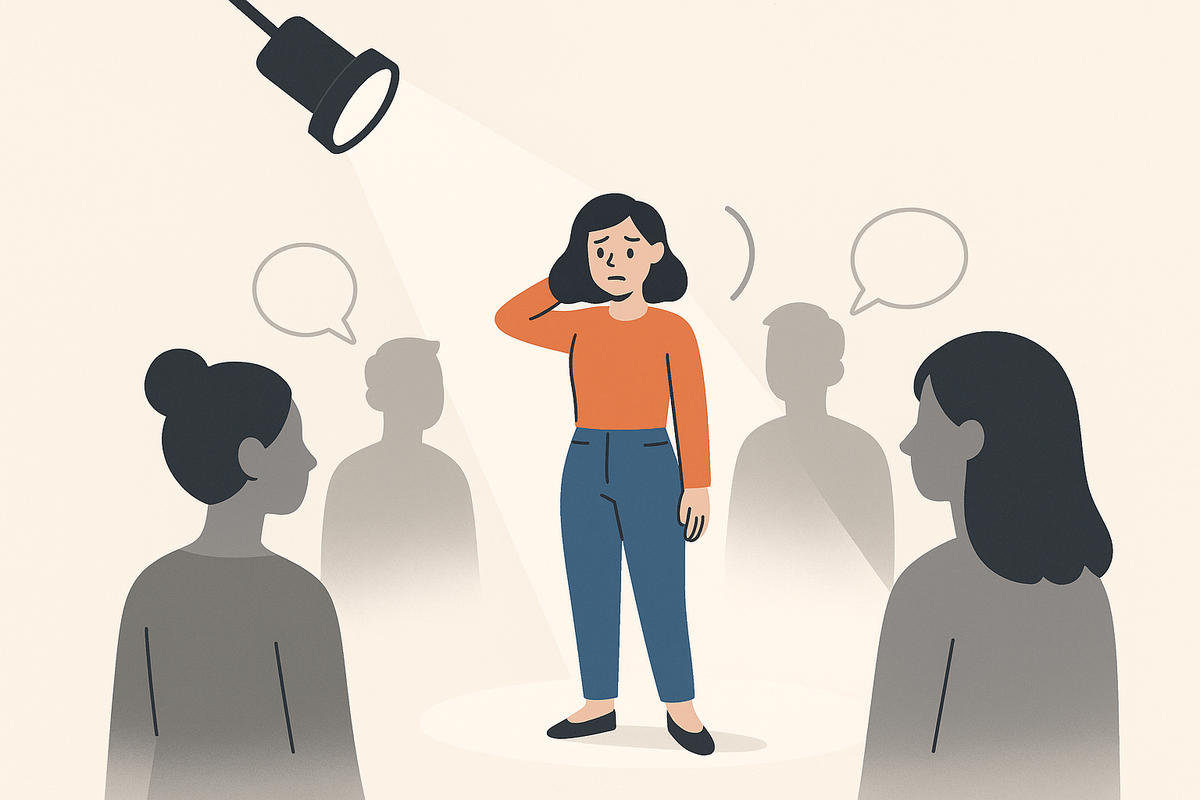
"What is the spotlight effect?" This common question reveals a widespread psychological phenomenon: people tend to believe they are being noticed and judged far more than they actually are. The spotlight effect is the cognitive bias that makes us think that all eyes are on us—whether we trip on a sidewalk, stumble over a word in a meeting, or wear a shirt with a stain. In reality, most people are wrapped up in their own thoughts and barely notice these small mishaps.
For example, imagine walking into a crowded room with a missing button on your shirt. You might feel the heat of imagined stares and imagine whispered conversations about your wardrobe. However, research and anecdotal evidence show that most attendees are preoccupied with their own appearance or anxieties. This disconnect between perception and reality is the heart of the spotlight effect. Even after a flubbed introduction or a visible mistake, others tend to forget quickly or not notice at all.
Origins of the Term
The term "spotlight effect" was coined by psychologists Thomas Gilovich, Victoria Husted Medvec, and Kenneth Savitsky in 2000. Their research highlighted how individuals feel as if they're under a literal spotlight, exaggerating the attention others pay to their actions or appearance. This bias is not about narcissism, but rather the natural result of being the center of your own experience.
Gilovich and his colleagues conducted a series of experiments to quantify this effect, showing over and over that people dramatically overestimate how much others notice their blunders or choices. The concept has since become a staple in social psychology and is referenced in both academic literature and popular culture to explain why we feel scrutinized even when we’re not.
Real-World Relevance
- It affects people of all ages and backgrounds. Teenagers, adults, and even seasoned professionals can fall victim to the spotlight effect.
- It can intensify during social events, presentations, or any situation where you feel exposed, such as job interviews, networking events, or first dates.
- Many people ask themselves, "Do people notice me? Am I being judged?"—the spotlight effect is often the cause behind these worries.
- The effect can be especially pronounced in unfamiliar or high-stakes situations, where the fear of making a mistake is heightened.
Why It Matters
This phenomenon can lead to social anxiety, reduced self-confidence, and missed opportunities. Understanding the spotlight effect is the first step to overcoming it and feeling more comfortable in your own skin. Recognizing that these feelings are a universal part of the human condition can be liberating and can help you approach social situations with greater ease and authenticity.
Moreover, being aware of the spotlight effect is essential for anyone interested in personal growth or social success. It can help you take healthy risks, engage more freely, and enjoy social connections without the burden of imagined scrutiny.
Section 2: Spotlight Effect Psychology
Core Psychological Mechanisms
The spotlight effect in psychology is grounded in several well-established cognitive principles. Chief among them is the "egocentric bias"—the tendency for people to rely heavily on their own perspective when interpreting the world. Because we are so focused on ourselves, we naturally overestimate how much others are as well. This leads to the persistent feeling of being observed and judged.
Egocentric bias is a byproduct of how our brains process information: We have immediate access to our own thoughts, feelings, and intentions, but not to those of others. As a result, we use our own experiences as a reference point, inadvertently projecting our self-focus onto the minds of those around us. This is not a flaw, but rather an evolutionary adaptation that helps us navigate complex social environments, albeit with some cognitive distortion.
Supporting Studies and Experiments
- Gilovich et al.'s classic T-shirt study: Volunteers wore an embarrassing shirt (featuring Barry Manilow) and estimated that nearly half the people in a room noticed it. In reality, only about 23% did. This study highlights the dramatic gap between our perception and reality regarding social attention.
- Public speaking research: In studies where participants gave short speeches and rated how nervous they appeared, observers consistently rated them as less anxious than the speakers themselves believed. This demonstrates how our internal experience of self-consciousness does not match external perceptions.
- Memory studies: Other research has shown that people tend to overestimate how memorable their mistakes or awkward moments are to others. For example, after a social blunder, individuals might believe it will be remembered for weeks, but follow-up interviews with observers reveal it is often forgotten within hours or days.
Self-Consciousness and Social Context
The spotlight effect is particularly strong in situations where social evaluation seems likely, such as public speaking, dating, or job interviews. People with higher levels of self-consciousness or social anxiety are even more prone to this effect.
Social context matters. In unfamiliar or hierarchical settings—like presenting in front of superiors or meeting new people—the pressure of being evaluated increases, and so does the spotlight effect. Conversely, in familiar or supportive environments, its influence often lessens.
Related Concepts
- Illusion of transparency: The belief that our emotions and thoughts are more obvious to others than they actually are. For instance, feeling certain that everyone knows you’re nervous when your outward appearance is calm.
- Egocentrism: Placing yourself at the center of attention, even when it's not warranted. This is a normal developmental phase in childhood but can persist in subtle ways into adulthood.
Understanding spotlight effect psychology can help you recognize when your thoughts are leading you astray, paving the way for healthier self-perception. For a deeper look at how others perceive us, the post How Do Others Perceive Me Quiz: Uncover Your True Social Reflection explores these blind spots in more detail.
Section 3: Spotlight Effect Examples in Daily Life
Everyday Situations
Spotlight effect examples are everywhere in daily life. Here are some of the most common scenarios where people overestimate how much others notice or remember their actions:
- Wardrobe Mishaps: Spilling coffee on your shirt before a meeting and feeling everyone is staring at the stain, when in reality, most people never notice or quickly forget.
- Public Speaking: Believing that a stumble over words or a slight shake in your voice is painfully obvious to the audience. In fact, most listeners are focused on the content or their own worries about public speaking.
- Social Media Posts: Fearing that a typo or awkward photo will be scrutinized by all your followers. But with the volume of content online, very few people notice or remember small errors.
- Entering a Room: Feeling as if all eyes are on you when you walk into a crowded space late. Research shows most people register your presence briefly, if at all, before returning to their own conversations.
- Physical Appearance: Obsessing over a bad hair day or a pimple, convinced everyone will notice. In practice, most people are too wrapped up in their own appearance worries to focus on yours.
- Mistakes at Work: Believing that a minor mistake in an email or during a team meeting is a career-defining moment. Often, colleagues are more empathetic than we realize, or they forget these moments quickly.
- Performance Anxiety: Musicians, athletes, and performers frequently feel that an error is glaringly obvious to their audience, but post-event feedback shows that most slip-ups go unnoticed or are quickly forgiven.
Am I Being Judged?
One of the most persistent worries is: "Am I being judged right now?" Research consistently shows that, while it’s natural to feel this way, most people are far too focused on themselves to pay close attention to the small things you do. In fact, people tend to forget others' minor mistakes quickly.
Consider the last time you witnessed someone else’s minor blunder. Chances are, you noticed it fleetingly—if at all—and then moved on. This is the same perspective most people have when you make a mistake.
Do People Notice Me?
- At a party, you may worry that everyone saw you drop your drink, but chances are only a few people even noticed—and fewer cared. Most guests are engaged in their own conversations.
- When you answer a question incorrectly in class, you might believe it's the talk of the day. In reality, most classmates move on instantly, and the moment passes without lasting attention.
- Arriving late to a gathering can feel mortifying, but most people are focused on their own interactions and may not even register your entrance.
- Forgetting someone’s name in conversation might seem like a huge faux pas, but the other person is often understanding or may not even notice if you skillfully navigate the conversation.
Reflection
These examples illustrate how the spotlight effect can cause unnecessary stress. Being aware of this bias helps you put experiences in perspective and realize that your "audience" is rarely as attentive—or judgmental—as you fear.
Next time you catch yourself replaying an awkward moment or minor mistake, remind yourself that these moments are rarely as memorable to others as they are to you. Recognizing this can reduce anxiety and help you participate more fully in daily life.
Section 4: Why Do We Experience the Spotlight Effect?
Self-Centered Perception
Humans naturally view the world from a self-centered perspective. Since we are always immersed in our own thoughts, feelings, and experiences, it’s easy to assume that others are equally focused on us. This egocentric bias is the foundation of the spotlight effect. Even when we try to take another person’s point of view, our own experience acts as an anchor, skewing our judgment.
For instance, if you feel nervous during a speech, you may assume the audience can see your anxiety. In reality, your internal feelings are far more intense than any outward signs others might pick up. Our self-centered perception makes our mistakes feel bigger and more visible than they are to people around us.
Cognitive and Social Factors
- Attention Limits: People have limited attention spans and are usually preoccupied with their own concerns. Studies suggest we are bombarded with thousands of pieces of information daily, forcing us to filter out most of what’s happening around us—including the minor mishaps of others.
- Social Anxiety: Those who are more socially anxious are especially vulnerable to the spotlight effect, as they are hyper-aware of potential negative evaluation. Socially anxious individuals often interpret ambiguous social cues as negative, amplifying self-consciousness.
- Novelty and Salience: New or unusual events (like a wardrobe malfunction) seem more significant to us than to others, making us exaggerate their importance. If you rarely spill your drink, the one time it happens feels monumental to you, but unremarkable to everyone else.
- Self-Monitoring: People who score high in self-monitoring tend to be more aware of their behavior and how it might be perceived, making them more susceptible to the spotlight effect. This trait can be beneficial in certain contexts, like performance or leadership, but may increase self-consciousness in everyday interactions.
Developmental Aspects
Adolescents are particularly prone to the spotlight effect. Psychologists refer to this as the "imaginary audience"—a belief common in teenage years that everyone is watching and judging your every move. While this bias often lessens with age and experience, it can persist into adulthood, especially in high-pressure social situations.
During adolescence, the brain is undergoing significant changes, particularly in areas related to self-awareness and social cognition. This developmental stage makes teens acutely aware of how they might appear to others, often leading to self-consciousness that can feel overwhelming. As people mature, experiences and repeated exposure to social situations help recalibrate these perceptions, but the spotlight effect never disappears entirely.
Media and Modern Pressures
Social media amplifies the spotlight effect. The constant sharing and scrutiny can make people feel like they are always on stage, observed, and evaluated. This intensifies self-consciousness and the fear of being judged.
For example, posting a selfie or status update might trigger anxiety about how many likes or comments it receives—or about potential negative feedback. This digital environment reinforces the idea that others are constantly watching, even though most people are scrolling quickly or focusing on their own online presence. The curated nature of social media profiles also contributes, as people compare their real-life experiences with the highlight reels of others, further distorting perceptions of attention and judgment.
Section 5: How the Spotlight Effect Impacts Self-Image
Self-Image and Perceived Judgment
The spotlight effect can have a profound impact on your self-image and mental well-being. When you believe you are constantly being judged, you may become overly self-conscious, critical, or even anxious about your appearance and behavior. This distortion can limit your willingness to take risks, try new things, or be authentic in social settings.
Over time, this can contribute to the development of negative self-talk—internal dialogues that reinforce feelings of inadequacy or insecurity. For example, after a minor social slip, you might replay the moment in your mind, convincing yourself that others now see you as awkward or incompetent. This cycle can erode self-esteem and make socializing feel like a minefield.
Consequences of Overestimating Attention
- Social Avoidance: Avoiding activities or events for fear of embarrassment. This can lead to isolation and missed opportunities for connection or professional growth.
- Perfectionism: Trying to control every aspect of your appearance or performance to avoid imagined criticism. This can result in stress, burnout, and a constant sense of falling short.
- Impaired Confidence: Doubting your abilities because you assume others are scrutinizing your every move. This can lower self-efficacy and make it harder to pursue goals.
- Missed Opportunities: Passing up experiences or connections due to fear of negative judgment. Whether it's declining a speaking engagement, avoiding networking events, or hesitating to make new friends, opportunities for personal and professional growth can be lost.
- Increased Vulnerability to Criticism: When you believe others are always watching, even minor feedback can feel devastating, further reinforcing the cycle of self-doubt.
Bridging the Perception Gap
Becoming aware of the spotlight effect allows you to challenge false beliefs about how much others notice or care about your actions. One way to bridge the gap between self-perception and reality is to seek honest feedback. Apps like Blindspot let you discover how your friends truly see you, helping you recalibrate your self-image and reduce unnecessary self-criticism.
For instance, after using Blindspot, users often discover that traits or moments they consider embarrassing are viewed as minor or even endearing by friends. This feedback can be a powerful antidote to distorted self-perceptions and can help you develop a more balanced, compassionate view of yourself. Direct feedback also exposes blind spots—areas where your self-image doesn't match how others actually perceive you, whether that's underestimating your humor, kindness, or leadership qualities.
Related Resource
For more on how friends influence your self-image, see the post How Friends Shape Our Self-Image: The Hidden Impact, which explores the dynamic between self-perception and others’ feedback.
Section 6: Overcoming the Spotlight Effect with Self-Discovery Tools
Practical Strategies
Overcoming the spotlight effect requires both insight and action. Here are several research-backed strategies to help reduce self-consciousness and boost confidence:
- Reality Testing: Remind yourself that people are usually focused on themselves, not on you. If possible, ask someone you trust whether they noticed your "big mistake." Odds are, they didn’t. Journaling about your feelings after social events and comparing them to actual outcomes can help you see the gap between perception and reality.
- Shift Attention Outward: Focus on others in social situations. Listen actively and ask questions—this reduces self-focus and anxiety. For example, at a networking event, challenge yourself to learn three new things about the people you meet instead of worrying about your own impression.
- Practice Self-Compassion: Accept that mistakes and awkward moments happen to everyone. Treat yourself with kindness instead of harsh criticism. Self-compassion practices, such as mindfulness meditation or positive self-affirmations, can help reframe negative self-talk.
- Gradual Exposure: Place yourself in mildly uncomfortable situations and observe how little others notice or care. Over time, your anxiety will decrease. For example, intentionally wear mismatched socks to a casual outing and notice that most people either don't care or don't notice at all.
- Reframe Negative Thoughts: When you catch yourself catastrophizing about being judged, challenge those thoughts. Ask yourself, "What evidence do I have that others noticed or cared?" and "How would I treat a friend in this situation?"
- Seek Constructive Feedback: Instead of avoiding feedback, actively seek it from people you trust. Honest perspectives from friends, colleagues, or mentors can reveal that your self-criticisms are often exaggerated or unfounded.
Leveraging Technology
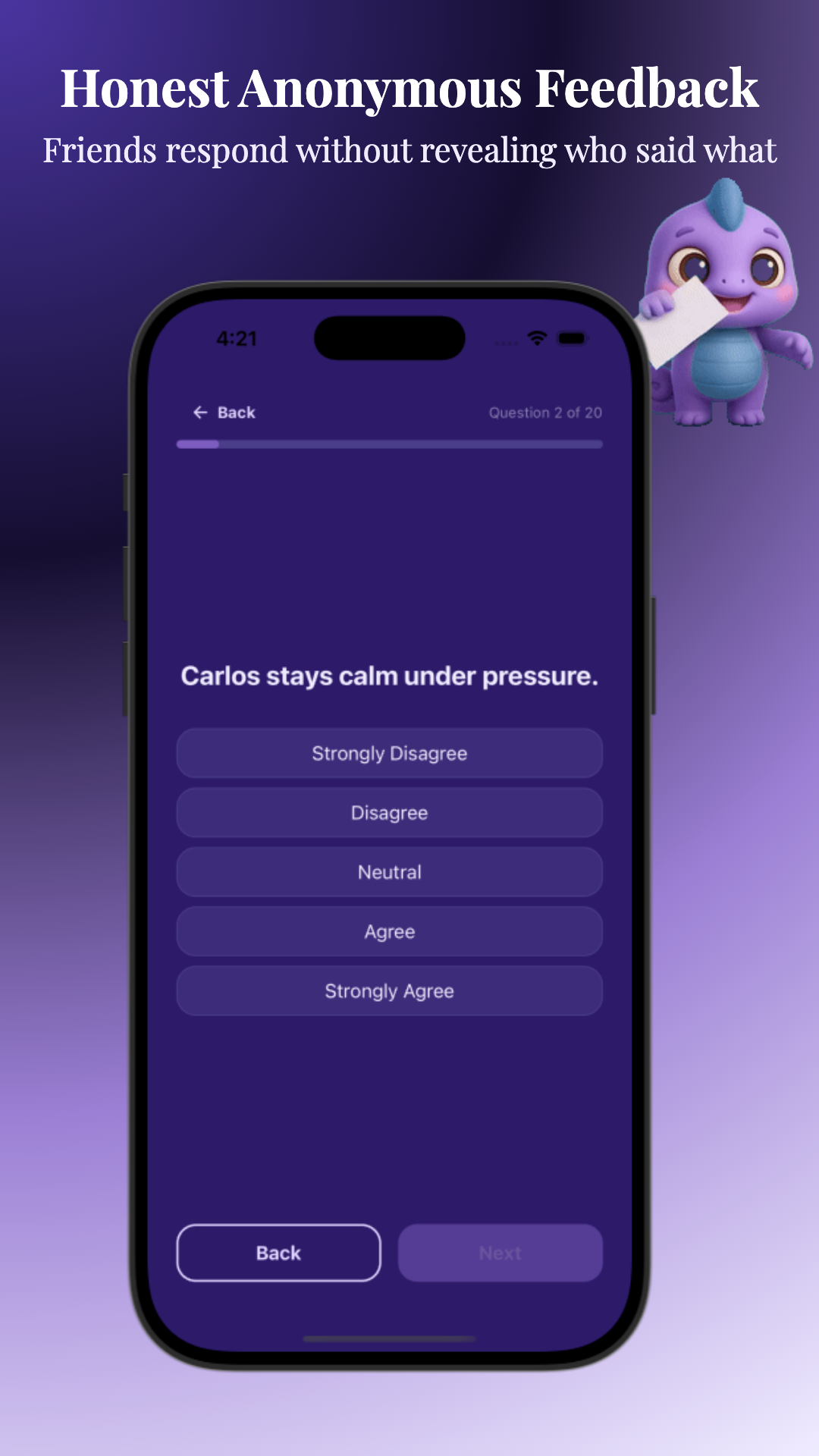
Digital self-discovery tools, like the Blindspot app, can accelerate the process of overcoming the spotlight effect. Blindspot enables you to invite friends to answer questions about you—anonymously—so you can see the gap between how you see yourself and how others see you. This evidence-based feedback helps recalibrate your assumptions about being noticed or judged.
Unlike traditional self-reflection exercises, Blindspot makes it easy and safe to gather honest input, which can be especially valuable if you struggle with self-doubt or social anxiety. By anonymizing responses, the app encourages candid feedback, reducing the fear of offending or being judged by your peers. This can help you pinpoint both your strengths and areas for growth—giving you a clearer, more objective picture of how you actually come across in social situations.
Actionable Steps with Blindspot
- Create a group and invite friends to answer personality or behavior questions about you. You can ask about specific traits (like confidence or empathy) or about how you’re perceived in group settings.
- Receive anonymous feedback, highlighting areas where you may have "blind spots." For example, you may discover that you’re seen as more approachable or supportive than you thought.
- Use Blindspot's AI insights to set personal growth goals and track your progress. The app can identify patterns in feedback and suggest actionable steps, such as practicing a new skill or reframing negative self-talk.
This process can be eye-opening, showing that the things you worry most about are often barely noticed by others. To dive deeper into actionable feedback, check out How to Get Honest Feedback from Friends: A Practical Guide.
For maximum benefit, consider making feedback a regular part of your self-development routine. Over time, you’ll gather enough data to see consistent patterns and adjust your self-image accordingly. This can help you break free from the grip of the spotlight effect and cultivate greater confidence in social situations.
Conclusion
The spotlight effect is a universal psychological bias—one that can hold you back if left unchallenged. By understanding what the spotlight effect is, recognizing its manifestations in your life, and using strategies and tools like Blindspot to gather real feedback, you can bridge the gap between perception and reality. Remember, most people are wrapped up in their own concerns, not yours. Gaining this insight can free you from unnecessary self-consciousness and empower you to engage more authentically with the world.
Taking concrete steps—like reality testing, shifting your focus outward, and seeking honest feedback—can dramatically lessen the impact of the spotlight effect over time. Leveraging technology, such as Blindspot, can make self-discovery more accessible and actionable than ever. Ultimately, freeing yourself from the illusion of constant scrutiny allows you to show up more confidently, take healthy risks, and enjoy richer social experiences. The journey starts with awareness and is powered by honest reflection and feedback.
FAQ
Q: What is the spotlight effect in psychology?
A: The spotlight effect in psychology refers to the tendency to overestimate how much others notice and judge our actions or appearance. It’s rooted in egocentric bias and is supported by numerous psychological studies.
Q: Can the spotlight effect cause social anxiety?
A: Yes. The spotlight effect can increase feelings of self-consciousness and social anxiety, making people fear they are constantly being judged—even when they are not.
Q: What are some spotlight effect examples?
A: Examples include thinking everyone noticed you tripping, obsessing over a minor wardrobe malfunction, or worrying that a public speaking slip was memorable to everyone present—when in reality, most people didn’t notice or quickly forgot.
Q: How can I stop worrying if people notice me?
A: Remind yourself that most people are focused on themselves. Try shifting your attention outward and seek honest feedback to correct exaggerated self-perceptions. Using self-discovery tools like Blindspot can also help.
Q: Is the spotlight effect permanent?
A: No. With self-awareness and practice, you can reduce its impact and gain a more balanced, confident self-image.