VR Personality Quiz: Exploring Self-Discovery Through Virtual and Augmented Reality
Discover your personality like never before with a VR personality quiz. Engage in immersive self-discovery and augmented reality personality tests.

Estimated reading time: 9 minutes
Key Takeaways
- Immersive assessment: VR & AR tests capture gaze, motion, and interactions for authentic data.
- Machine learning mapping: Algorithms translate behaviors into frameworks like HEXACO.
- Dynamic experiences: Branching scenarios and gamified tasks boost engagement and insights.
- Real-time feedback: Interactive dashboards and virtual coaches guide self-discovery.
- Future-ready: AI-adaptive scenarios, multiplayer VR, wearables, and ethical considerations.
Table of Contents
- 1. Introduction to VR & AR Personality Testing
- 2. Setting the Stage – Understanding VR Personality Quiz Tech
- 3. How Immersive Experiences Transform VR Personality Quiz
- 4. Innovative Quiz Mechanics
- 5. The Self-Discovery Journey
- 6. Future Trends & Implications
- 7. Conclusion
Introduction to VR & AR Personality Testing
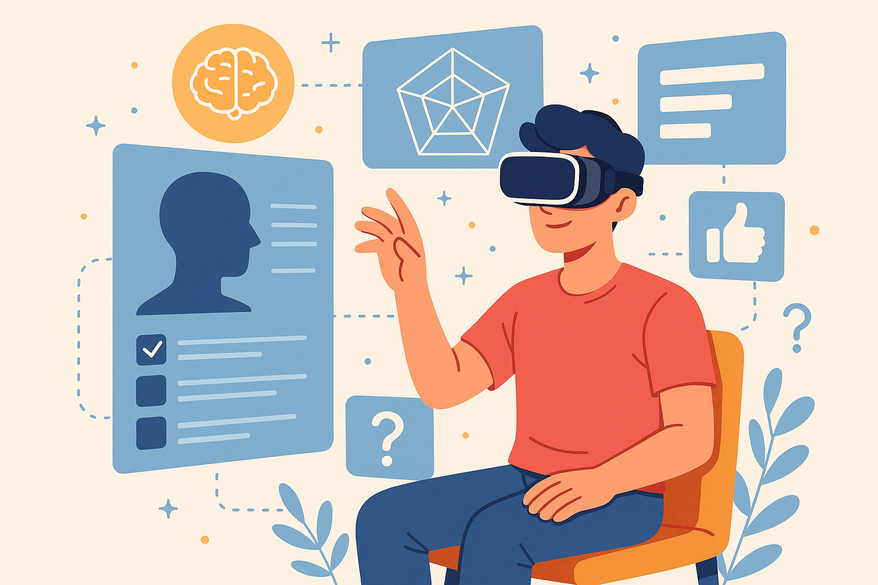
An immersive VR personality quiz blends virtual reality self-discovery with an augmented reality personality test to move beyond static surveys. Users wear head-mounted displays (HMDs) and AR glasses as they navigate simulated worlds, while algorithms log gaze, movement, and choices to reveal deeper personality layers. These mixed-reality experiences deliver real-time feedback and authentic insights that traditional questionnaires simply can’t match.
For a more accessible way to identify blind spots with your social circle, try the Blindspot App. It lets you anonymously gather friend feedback and compare it to your self-assessment for immediate growth insights.
Section 1: Setting the Stage – Understanding VR Personality Quiz Tech
Defining the VR Personality Quiz
A VR personality quiz uses HMDs like Oculus Quest or HTC Vive to immerse you in social scenarios, puzzle worlds, or crisis simulations. As you interact:
- The system logs your choices, gaze patterns, motion paths, and interaction speed.
- Machine learning engines map these implicit behaviors to personality frameworks, mirroring AI-driven insights popularized in modern tools.
Traditional Tests vs. Immersive Assessment
- Traditional quizzes rely on self-report answers, prone to social desirability bias.
- VR captures real-time reactions under simulated stress, collaboration, or novelty.
- Outcome: richer behavioral data, revealing what you do, not just what you say.
Defining Augmented Reality Personality Test
An augmented reality test overlays digital prompts or avatars onto your real environment via mobile devices or AR glasses:
- Avatars appear in your living room, asking you to organize objects or solve tasks.
- The system tracks spatial interactions and gaze to infer traits.
Technical Deep-Dive
- Head-Mounted Displays: Oculus Quest, HTC Vive, Valve Index.
- Motion Trackers: infrared sensors, inside-out tracking cameras.
- Behavior-Inference Engines: machine learning models trained on labeled datasets.
- Personality Framework: the HEXACO model overview, with other frameworks like the Understanding the Big Five Personality Test guide and comprehensive resources on MBTI, Big Five, and self-discovery.
Section 2: How Immersive Experiences Transform VR Personality Quiz
Benefit 1: Enhanced Engagement & Presence
- Immersive environments boost presence, making responses feel authentic.
- Users report higher emotional involvement, reducing the “test-taking” mindset.
Benefit 2: Realistic Scenarios Reveal Coping Styles
- Negotiation tasks highlight conflict resolution styles.
- Crisis simulations reveal stress responses under pressure.
- Group tasks measure collaboration tendencies.
Benefit 3: Implicit Behavioral Metrics
- Hesitation time, risk-taking choices, persistence tracked instead of self-ratings.
- Continuous data streams yield accurate trait inference.
Augmented Reality Complement
- Lightweight AR prompts during daily routines capture habitual patterns.
- Reaction to interruptions and spatial organization skills are logged.
Research Evidence
- The “Feasibility of virtual reality and machine learning to assess personality” study confirms VR behavior predicts personality dimensions.1
- PwC KOIA platform overview uses gamified VR tasks to measure HEXACO traits in hiring assessments.3
Section 3: Innovative Quiz Mechanics
Structure & Flow
- Onboarding & Calibration
- Avatar creation and motion calibration ensure tracking accuracy.
- Baseline tasks measure comfort and reaction speed.
- Phase-Based Environments
- Openness: creative exploration in surreal worlds.
- Conscientiousness: timed puzzle challenges under pressure.
- Extraversion/Agreeableness: collaborative social scenarios.
- Dynamic Branching
- Scenarios adapt based on earlier behavior for deeper insights.
- Feedback & Results
- Interactive personality map showing trait levels.
- Virtual coach avatar delivers commentary and growth tips.
Tech Stack Deep-Dive
- Spatial Computing Frameworks: Unity, Unreal Engine, ARKit, ARCore.
- Data Pipelines & Security: GDPR-compliant storage, encrypted telemetry.
Section 4: The Self-Discovery Journey
Step-by-Step User Journey
- Launch & Calibration: system checks HMD fit, controllers, and room scale.
- Immersion: tasks trigger different personality dimensions.
- Data Logging: gaze, movement, decision timestamps recorded.
- Receive Dashboard: strengths-focused charts link behaviors to traits.
- Post-Session Reflection: access recommended VR modules for growth.
Emotional & Cognitive Benefits
- Game-like UX reduces test anxiety.
- “Living” scenarios yield deeper self-awareness than hypothetical questions.
- Instant visual feedback shows real-time metrics on confidence or risk appetite.
Practical User Tips
- Choose a quiet, safe space to avoid interruptions.
- Approach authentically—view the quiz as exploration, not an exam.
- Journal post-session: note the virtual moments that felt most revealing.
Section 5: Future Trends & Implications
AI-Driven Adaptive Scenarios
- Scenarios evolve with each session for longitudinal tracking.
- Algorithms refine difficulty and context based on prior behavior.
Social Multiplayer VR Assessments
- Group dynamics reveal leadership and teamwork skills.
- Multi-user sessions simulate real-world challenges.
Wearable Integration
- Heart rate and facial expression analysis enrich emotional profiling.
- Combined with behavioral metrics for holistic assessment.
AR Background Assessments
- Observe daily posture and interaction patterns via smartphone sensors.
- Deliver subtle AR prompts in everyday settings.
Impacts on Development & Mental Health
- Tailored VR modules for CBT based on assessed traits.
- Adaptive learning platforms adjust pacing and style.
- Ethics-driven VR hiring tools ensure fairness (e.g., PwC KOIA model).
Ethics & Privacy Considerations
- Informed consent with clear data-use explanations.
- Encryption in transit and at rest, GDPR/CCPA compliance.
- Transparent AI models with user feedback.
Conclusion
The VR personality quiz represents a shift from static surveys to dynamic, behavior-driven self-discovery. By merging virtual reality self-discovery with an augmented reality personality test, these tools deliver immersive engagement, authentic data, and immediate feedback. Ready to explore who you truly are? Try a demo VR personality quiz or AR personality test today and unlock deeper self-insight. For more user-friendly self-awareness tools, check out our Best Self Awareness App 2026.
FAQ
- What equipment do I need? You’ll need a compatible HMD (e.g., Oculus Quest) and, for AR tests, a smartphone or AR glasses.
- How accurate are VR personality quizzes? Studies like the Frontiers in Psychology research show high predictive validity compared to self-report surveys.1
- Is my data secure? Leading platforms use GDPR-compliant storage and encrypted telemetry to protect user privacy.
- How long does a session take? Most quizzes last 20–30 minutes, including calibration and feedback.
- Can I share my results? Yes, you can export interactive dashboards or share summary reports with friends or coaches. For insights on how others perceive you, consider reading How Others See You: Understanding and Bridging the Perception Gap.