What Personality Type Am I? The Ultimate Guide to Personality Frameworks
Discover what personality type you are with MBTI, Big Five, and more. Learn how self-perception and feedback reveal your true traits. Start your journey today.

Estimated reading time: 16 min
Key Takeaways
- "What personality type am I?" is a question best answered by exploring multiple frameworks—MBTI, Big Five, and real-world feedback.
- Understanding your personality traits helps you grow, build stronger relationships, and choose fitting careers.
- Self-perception is shaped by cognitive biases, making honest feedback from others crucial for self-awareness.
- Both nature and nurture influence your personality, so your traits can evolve with experience and effort.
- Personality tests are powerful self-discovery tools—but they're not perfect or absolute.
Table of Contents
- Section 1: MBTI Explained and the 16 Personality Types
- Section 2: Big Five Personality Traits – The Scientific Approach
- Section 3: How to Find Out What Personality Type You Are
- Section 4: Cognitive Biases and the Gap Between Self-View and Reality
- Section 5: Personality Type in Relationships, Work, and Communication
- Section 6: Other Popular Personality Frameworks and Their Validity
- Conclusion
- FAQ
Section 1: MBTI Explained and the 16 Personality Types
What Is MBTI?
The Myers-Briggs Type Indicator (MBTI) is one of the world's most famous personality assessment tools, designed to answer the perennial question: What personality type am I? MBTI sorts people into 16 distinct personality types based on four dichotomies, each reflecting a core aspect of how you take in information and make decisions. The MBTI was developed by Katharine Cook Briggs and her daughter Isabel Briggs Myers, inspired by Carl Jung’s theory of psychological types. Today, MBTI is used in personal development, workplace training, education, and even relationship counseling worldwide. Over two million people reportedly take the MBTI each year, making it one of the most widely used personality frameworks in the world.
Despite some criticism about its scientific rigor, many find MBTI helpful for understanding themselves and others. The framework provides a shared vocabulary for talking about preferences and differences, which can be especially valuable in a group or organizational setting.
The Four MBTI Dichotomies
- Extraversion (E) vs. Introversion (I): Do you draw energy from social interaction (E) or solitude (I)? Extraverts often feel recharged by group activities and external stimulation, while introverts prefer quiet environments, reflection, and one-on-one connections. For example, an extravert might thrive at a bustling networking event, while an introvert may find it draining and need time alone afterward to recharge.
- Sensing (S) vs. Intuition (N): Do you focus on concrete details (S) or bigger-picture concepts (N)? Sensors are drawn to what’s real, practical, and tangible—they notice specifics and remember facts well. Intuitives look for patterns, possibilities, and abstract meanings, often preferring theory and ideas over hard data. For instance, a Sensing type might excel in accounting or quality control, while an Intuitive might gravitate toward strategy or creative roles.
- Thinking (T) vs. Feeling (F): Do you prioritize logic (T) or personal values and emotions (F) when making decisions? Thinkers value objectivity, consistency, and fairness, often making decisions based on logical analysis. Feelers put a premium on empathy, harmony, and personal impact, considering how choices affect others’ feelings. In a workplace scenario, a Thinker may focus on efficiency, while a Feeler might prioritize team morale.
- Judging (J) vs. Perceiving (P): Do you prefer structure and plans (J) or flexibility and spontaneity (P)? Judging types like order, clear timetables, and closure. They’re planners who appreciate deadlines and checklists. Perceivers are adaptable, open to new information, and comfortable with change. They may thrive in dynamic environments where priorities shift rapidly.
The 16 MBTI Types
Each personality type is a combination of the above letters, e.g., INTJ, ESFP, INFJ, etc. Here’s a quick overview of all 16:
- ISTJ: Responsible, organized, practical. Often called the "Inspector," ISTJs value traditions and are detail-oriented, making them excellent at managing logistics or enforcing policies.
- ISFJ: Supportive, reliable, observant. Known as the "Defender," ISFJs are motivated to help and protect others, often thriving in caring professions like nursing, teaching, or social work.
- INFJ: Insightful, principled, empathetic. Nicknamed the "Advocate," INFJs combine creativity with a deep sense of integrity and often feel called to make a difference in the world, whether through art, activism, or counseling.
- INTJ: Strategic, independent, analytical. The "Architect" is a long-range planner, excelling in roles that require strategic thinking and problem-solving, such as research or entrepreneurship.
- ISTP: Logical, adventurous, adaptable. As the "Virtuoso," ISTPs are practical experimenters, often excelling in hands-on technical fields like engineering, mechanics, or emergency response.
- ISFP: Gentle, creative, flexible. ISFPs, the "Artist" type, value harmony and beauty, frequently expressing themselves through design, music, or craftsmanship.
- INFP: Idealistic, sensitive, loyal. The "Mediator" is guided by strong inner values and a desire to help others, making them well suited for writing, counseling, or advocacy roles.
- INTP: Curious, inventive, objective. INTPs are "Thinkers"—innovative and theoretical, drawn to philosophy, science, or any field where ideas are king.
- ESTP: Energetic, perceptive, direct. The "Entrepreneur" loves action and excitement, thriving in fast-paced roles like sales, sports, or crisis management.
- ESFP: Spontaneous, sociable, playful. Known as the "Entertainer," ESFPs bring energy to any group, often excelling in performance, teaching, or customer-facing jobs.
- ENFP: Enthusiastic, imaginative, friendly. The "Campaigner" is an idea person, energized by possibilities and often drawn to creative, people-centered careers.
- ENTP: Innovative, outspoken, resourceful. ENTPs are "Debaters," loving argument and innovation, making them strong in entrepreneurship, consulting, or invention.
- ESTJ: Decisive, organized, assertive. Called the "Executive," ESTJs are natural organizers and leaders, drawn to management and administrative roles.
- ESFJ: Warm, responsible, cooperative. The "Consul" excels in social coordination, often becoming community leaders or effective team players in service-oriented fields.
- ENFJ: Charismatic, supportive, persuasive. ENFJs, the "Protagonists," are driven to help others grow and succeed, thriving as teachers, coaches, or leaders.
- ENTJ: Efficient, strategic, confident. The "Commander" is goal-oriented and decisive, often rising to leadership positions in business or public service.
People sometimes get an additional label—Assertive (A) or Turbulent (T)—to show self-confidence or sensitivity to stress, especially in MBTI-style online tests. For example, an INTJ-A may be more self-assured, while an INTJ-T might be more self-critical and motivated by stress.
What MBTI Can Tell You
MBTI can help you understand your work style, communication preferences, and even how you approach relationships. For example, being aware that you are a Judging type can help you recognize your need for structure, while knowing you are more Perceiving might encourage you to embrace flexibility. MBTI can also clarify why certain tasks feel energizing and others depleting, and why you may connect more naturally with people who share your preferences. For an even deeper dive, check out our guide on revealing your blind spots through feedback.
However, it’s important to remember that MBTI types are not boxes—everyone uses all eight preferences to some degree. Your type simply describes what you do most comfortably, not what you are capable of.
Section 2: Big Five Personality Traits – The Scientific Approach
What Are the Big Five Traits?
The Big Five Personality Traits, also known as the Five-Factor Model (FFM), are considered by psychologists to be the gold standard for modern personality science. Unlike MBTI, the Big Five is based on decades of empirical research and is widely accepted for its personality test accuracy. The model is built on five broad dimensions that summarize a wide range of human personality characteristics. The Big Five traits are:
- Openness to Experience: Creative, curious, open-minded. People high in openness enjoy trying new things, exploring ideas, and appreciating art and adventure. Someone low in openness may prefer familiar routines and practical solutions.
- Conscientiousness: Organized, dependable, self-disciplined. Highly conscientious people are reliable, plan ahead, and are careful about details. Those low in this trait may be spontaneous but can struggle with deadlines or organization.
- Extraversion: Outgoing, energetic, seeks stimulation. High scorers are sociable and assertive, while low scorers (introverts) are reserved and independent.
- Agreeableness: Compassionate, cooperative, trusting. Those high in agreeableness are empathetic and eager to help others; those low may come across as blunt, skeptical, or competitive.
- Neuroticism: Sensitive to stress, emotionally reactive. People high in neuroticism may experience anxiety, mood swings, and self-doubt, while those low in this trait tend to be calm and resilient.
Measuring the Big Five
Each Big Five trait is a spectrum. For example:
- High Openness: Loves new experiences, art, and ideas. May be drawn to careers in research, design, or travel blogging.
- Low Conscientiousness: Dislikes routine, may struggle with organization. Such individuals often prefer creative or highly flexible roles but may find it difficult to meet deadlines or maintain structure.
- High Extraversion: Energized by social gatherings. For example, a high extraversion score might indicate someone who enjoys public speaking, sales, or organizing group events.
- Low Agreeableness: Prefers competition over cooperation. These individuals may excel in debating, law, or negotiation but could face challenges in teamwork or conflict resolution.
- High Neuroticism: Prone to anxiety and mood swings. This trait can be a double-edged sword: while it may foster empathy or creativity, it can also increase vulnerability to stress-related health issues.
Most people fall somewhere in the middle, showing mixtures of these traits. Some tests break each domain into six sub-facets (e.g., conscientiousness includes orderliness, self-discipline, and achievement-striving), allowing even greater specificity. This "trait, not type" approach means your personality profile is unique and not limited to a single category.
Big Five vs. MBTI
- The Big Five is more evidence-based and offers greater nuance (traits are measured on a scale, not "types"). Scores are typically reported on a percentile basis, so you can see exactly how you compare to the general population.
- MBTI is more user-friendly and popular, but less scientifically validated. MBTI's appeal comes from its clear, easy-to-understand categories, while the Big Five's strength lies in its research-backed reliability.
- Both frameworks can be helpful—think of MBTI as a broad "style," and Big Five as a detailed trait map. MBTI might help you understand your general tendencies, while the Big Five can inform how you respond to specific situations, such as stress, teamwork, or change.
Why the Big Five Matters
Big Five results are used in research on behavior, job performance, and even health. They’re also a great way to spot personality blind spots that can impact your life. For example, high neuroticism is associated with a greater risk for anxiety disorders, while high conscientiousness is linked to better academic and career success. Organizations sometimes use Big Five assessments in hiring, leadership development, or team-building activities because of their predictive value.
Understanding your Big Five profile can help you leverage your strengths and manage your challenges. If you’re low in extraversion but want to network more effectively, you can plan strategies to recharge between events. If you’re high in openness but struggle with follow-through, you might build routines to support your creativity.
Section 3: How to Find Out What Personality Type You Are
Taking Personality Tests
Today, there are countless free personality quizzes online that deliver instant results, from official MBTI and Big Five assessments to fun, informal "Which character are you?" quizzes. But not all tests are created equal in terms of accuracy or insight. Here’s how to navigate your options:
- Official MBTI: Usually paid, but reliable for MBTI-style results. The official MBTI assessment, administered by certified practitioners, provides a detailed report and is often used in corporate or counseling settings. While the cost can range from $50 to over $150, you get a robust analysis and personalized feedback.
- Big Five: Look for reputable sources like the IPIP-NEO or university-sponsored surveys. The IPIP-NEO (International Personality Item Pool) is free for personal use and provides a comprehensive profile across the five major traits and their sub-facets. Universities like Penn State or Cambridge often offer research-backed Big Five tests online as well.
- Free Quizzes: Great for a first look, but results may vary widely. Some popular sites offer "MBTI-style" quizzes with entertaining, easy-to-understand results; however, these may simplify or misinterpret the underlying theory. Use them as conversation starters or a jumping-off point for deeper exploration.
When choosing a test, consider the number of questions, the source’s reputation, and whether you receive a nuanced report or just a four-letter code. More comprehensive tests (with 60+ questions) tend to be more reliable than ultra-short quizzes.
Beyond Self-Assessment: Feedback from Others
Self-perception is often clouded by cognitive biases. To get a more accurate picture, try combining self-tests with honest feedback from friends, family, or colleagues. Blindspot lets your friends answer questions about you anonymously, revealing where your self-image matches—or clashes with—how others see you. For example, you may see yourself as reserved, but multiple friends might describe you as a natural leader in group settings. This can highlight traits you under- or overestimate in yourself. Try it at Blindspot.
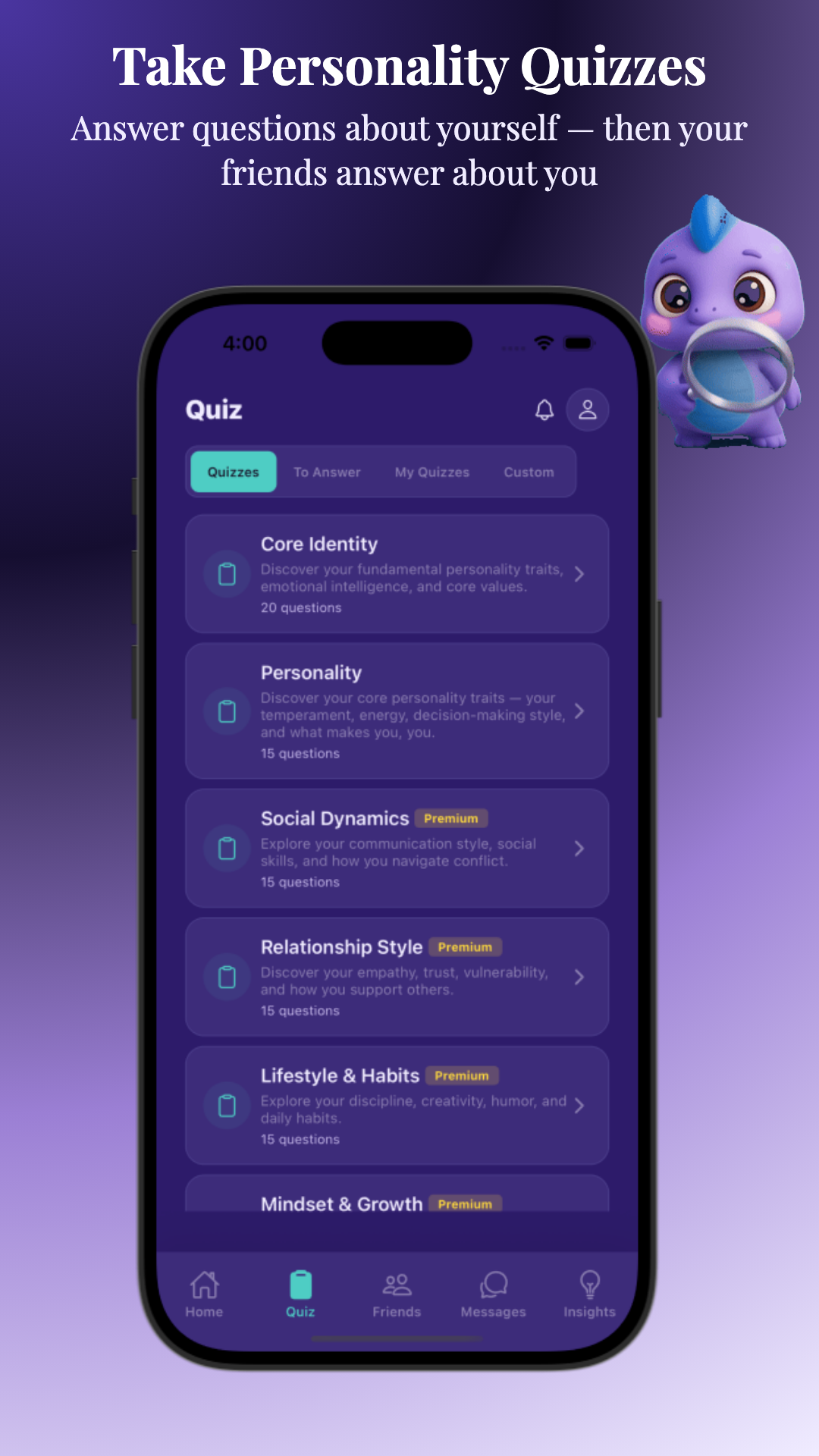
Feedback from others is especially valuable for traits like empathy, assertiveness, or communication style—qualities that strongly affect relationships but can be hard to evaluate alone. For the most useful feedback, ask specific questions (e.g., "How do I handle conflict?" or "What’s my biggest strength as a teammate?") and be open to constructive criticism.
Nature vs Nurture in Personality
- Genetics: Studies suggest 40-60% of your personality is inherited. Twin studies reveal that identical twins, even when raised apart, tend to show similar personality profiles, especially on traits like extraversion and neuroticism.
- Environment: Parenting, culture, peers, and life events shape the rest. Experiences like moving to a new country, facing adversity, or joining new social groups can nudge your traits in different directions. For instance, someone with a genetic predisposition to introversion may develop stronger social skills in a highly extroverted family environment.
- Change: While some traits are stable, major experiences (like trauma or travel) can shift your personality over time. Research shows that people often become more agreeable and conscientious as they age, reflecting increased maturity and stability. Conversely, significant life events—positive or negative—can lead to lasting personality changes.
For more hands-on advice, see our step-by-step guide to uncovering social blind spots. Remember, personality is not destiny; with self-awareness and effort, you can develop new habits, skills, and perspectives that shift your profile over time.
Section 4: Cognitive Biases and the Gap Between Self-View and Reality
Why Self-Perception Isn't Always Accurate
Even the best personality quizzes can only measure how you see yourself—not necessarily how you truly behave or how others experience you. This is due to cognitive biases, which are mental shortcuts that distort reality. For example, you might rate yourself as a great listener, but friends might see you as someone who often interrupts. These gaps matter: they can affect your relationships, career, and personal growth.
Common Cognitive Biases About Yourself
- Self-Serving Bias: Attributing successes to your abilities, failures to external factors. For example, if you ace a presentation, you credit your hard work; if it flops, you blame the audience or timing.
- Confirmation Bias: Seeking information that confirms what you already believe about yourself. If you think of yourself as helpful, you might remember every time you assisted someone but forget times you ignored a request.
- Spotlight Effect: Overestimating how much others notice your behavior. You may think everyone noticed your nervousness in a meeting, when most people were focused elsewhere.
- Dunning-Kruger Effect: Overrating your abilities in areas you know little about. For instance, you might believe you’re an excellent communicator simply because you've never received critical feedback, even if subtle issues persist.
Other biases include the halo effect (letting one positive trait shape your whole self-image) and negativity bias (over-focusing on your flaws). These biases are natural but can limit your self-awareness and growth unless consciously addressed.
The Value of External Feedback
To counteract these biases, it's vital to get honest feedback. Apps like Blindspot, or frameworks like the Johari Window Test, help you uncover the "blind spots" in your self-knowledge.
- Ask friends to describe your strengths and weaknesses. Use open-ended questions or structured surveys to get richer feedback.
- Compare your self-assessment to their feedback for deeper insight. Are there areas where you consistently over- or underestimate yourself?
- Reflect regularly to track your personal growth over time. Set reminders every few months to revisit your assessments and see what’s changed.
For practical steps, try our guide on getting honest feedback from friends. Remember, embracing feedback is a skill—respond non-defensively and look for patterns, not just isolated comments. The process can feel vulnerable, but genuine self-awareness is built on seeing yourself through multiple perspectives.
Section 5: Personality Type in Relationships, Work, and Communication
How Your Type Affects Relationships
Knowing your personality type sheds light on why you connect with some people and clash with others. For example:
- Introverts (I): Recharge alone, prefer deep one-on-one conversations. They may need space after social events and can feel overwhelmed by constant group interaction.
- Extraverts (E): Draw energy from group activities and lively discussions. They enjoy meeting new people and often feel isolated if left alone for long periods.
- Feelers (F): Value harmony and empathy in relationships. They are often sensitive to conflict and may avoid confrontation to preserve peace.
- Thinkers (T): Focus on logic and objectivity during conflicts. They may appear blunt or detached, but their aim is clarity, not hurt feelings.
Understanding these dynamics can reduce misunderstandings and strengthen your bonds. For example, an introvert and extravert couple might agree to schedule quiet time after parties, or a Thinker and Feeler team might balance tough decisions with empathy. Want to see how your friends perceive your social style? Try the How Do Others Perceive Me Quiz.
Personality and Career Fit
- ISTJs & ESTJs: Thrive in structured environments—think operations, law, finance. Their attention to detail and reliability make them natural choices for jobs that require precision and consistency.
- ENFPs & INFPs: Excel in creative roles—marketing, counseling, the arts. Their imagination and empathy let them innovate and connect deeply with others, often excelling in roles that require vision and emotional insight.
- ENTJs & INTJs: Natural strategists—management, consulting, entrepreneurship. They enjoy tackling complex problems and leading teams toward ambitious goals.
- Big Five: High conscientiousness predicts job performance across roles; high openness fits innovation-driven fields. For example, teachers, surgeons, and project managers often score high in conscientiousness, while artists and entrepreneurs tend to score high in openness.
Matching your career to your personality can boost satisfaction and performance. For instance, a highly agreeable person may thrive in HR or counseling, while someone low in agreeableness may be better suited for independent research or competitive sales.
Communication Styles by Type
- Extraverts: Talk things out, process ideas aloud. They may dominate meetings or brainstorming sessions but can overlook quieter voices.
- Introverts: Prefer written communication or time to reflect. They often excel in thoughtful emails and reports, but may need encouragement to share ideas in group settings.
- Judgers: Like clear plans and deadlines. They appreciate detailed agendas and follow-ups, and may get frustrated by last-minute changes.
- Perceivers: Adapt well to change and ambiguity. They’re comfortable brainstorming and pivoting quickly, but may struggle with rigid schedules or micromanagement.
Matching communication to your style—and recognizing others' styles—can prevent conflict and boost teamwork. For example, if you’re an extravert manager working with introverts, consider sending agendas ahead of meetings so everyone can prepare. If you’re a Perceiver on a Judging team, be mindful of deadlines and help the group stay flexible when change is needed.
Having open conversations about preferences can strengthen relationships. A simple question like "How do you prefer to receive feedback?" can go a long way in building trust and collaboration.
Section 6: Other Popular Personality Frameworks and Their Validity
Enneagram and Beyond
Beyond MBTI and the Big Five, several frameworks promise insight into "What personality type am I?" The most famous include:
- Enneagram: Nine interconnected types, each with core motivations and fears. For example, Type 1 (the Reformer) seeks integrity and purpose, while Type 7 (the Enthusiast) pursues variety and excitement. The Enneagram offers a dynamic model—types can shift under stress or growth, and each type has "wings" (neighboring influences) and connections to other types.
- DISC: Focuses on behavior in workplace settings—Dominance, Influence, Steadiness, Conscientiousness. DISC is often used for team building and leadership coaching, helping people understand their approach to tasks, collaboration, and conflict.
- StrengthsFinder: Identifies top strengths rather than weaknesses or "types." This tool, now called CliftonStrengths, is used in organizations to boost productivity by focusing on what people do best, such as "Achiever," "Input," or "Communication."
Other frameworks include the Hogan Personality Inventory (used for leadership assessment), the HEXACO model (adds a sixth trait: Honesty-Humility), and even astrology-based personality systems. While these can offer useful language for self-reflection, their scientific grounding varies.
Personality Test Accuracy
- MBTI: Fun and insightful, but lacks scientific backing and can change over time. Studies show that up to 50% of people get a different type when retaking MBTI after a few weeks or months, especially if they are near the midpoint on any given dichotomy.
- Big Five: Backed by decades of research; highly reliable for most people. Scores tend to remain stable over time, especially in adulthood, and the model is cross-culturally validated.
- Enneagram: Popular for personal growth, but less research-supported. Many users find its focus on motivation and inner fears helpful for self-discovery and relationships, but scientific validation is limited.
- Online Quizzes: Vary in quality—use them as conversation starters, not diagnoses. Some quizzes are based on rigorous frameworks, while others are designed primarily for entertainment. Always consider the source and methodology before making major decisions based on an online test.
When using any framework, consider it a tool—not a final answer. Your personality is complex and multi-faceted, and no single test captures every nuance.
Nature vs Nurture Revisited
All frameworks agree: both genetics (nature) and life experience (nurture) shape who you are. While your core tendencies are partly inherited, your environment, culture, and intentional efforts can help you evolve. For instance, someone born with high neuroticism might learn coping skills that reduce anxiety’s impact over time, while someone naturally introverted might develop strong public speaking skills through practice and exposure.
For a deeper look at how friends influence your self-image, read How Friends Shape Our Self-Image: The Hidden Impact. The people you surround yourself with can reinforce or challenge your self-perceptions, encouraging growth or, at times, holding you back. Choosing supportive, honest friends and mentors can accelerate your personal development.
Conclusion
Finding the answer to "What personality type am I?" is a journey, not a destination. Whether you favor MBTI's 16 types or the nuanced Big Five personality traits, self-discovery is most powerful when you combine self-reflection with honest, external feedback. Tools like Blindspot can help you bridge the gap between how you see yourself and how others see you, revealing blind spots and opening up new paths for personal growth.
Remember, personality frameworks are guides—not verdicts. Embrace their insights, but stay open to growth and change. Even if a test suggests you are unlikely to excel at sales, you may develop those skills with deliberate practice and feedback. Use these tools to play to your strengths, address your limitations, and communicate more effectively with others.
Want more ways to explore your self-image? Try the Johari Window for a structured feedback approach in our detailed Johari Window Questionnaire guide. Ultimately, the most accurate picture of your personality emerges when you integrate self-knowledge, scientific frameworks, and the perspectives of the people who know you best.
FAQ
Q: What personality type am I based on my traits?
A: Your personality type depends on your preferences across key traits like introversion/extraversion, intuition/sensing, thinking/feeling, and judging/perceiving (MBTI), or your position on the Big Five traits (openness, conscientiousness, extraversion, agreeableness, neuroticism). Taking reputable tests and comparing self-perception with feedback from others is the most accurate way to identify your type.
Q: How do I find out my MBTI type?
A: The best way is to take an official MBTI assessment or a high-quality free quiz. Pay attention to your natural tendencies in social situations, decision-making, and problem-solving. For even more accuracy, ask friends to describe you or use feedback-based tools like Blindspot.
Q: What is the most accurate free personality test?
A: For scientific accuracy, Big Five-based tests like the IPIP-NEO are considered the most reliable. Free MBTI-style quizzes are fun and insightful, but their accuracy varies. Combining quizzes with honest feedback from those who know you well gives the fullest picture.
Q: What are the 16 personality types?
A: The 16 MBTI types are: ISTJ, ISFJ, INFJ, INTJ, ISTP, ISFP, INFP, INTP, ESTP, ESFP, ENFP, ENTP, ESTJ, ESFJ, ENFJ, ENTJ. Each is a combination of preferences around energy, information, decisions, and lifestyle.
Q: What does my personality type say about my career or relationships?
A: Your type highlights your strengths, work style, and how you relate to others. For example, extroverts often thrive in team settings, while introverts may prefer independent roles. Understanding your type can help you choose compatible careers and improve communication with partners and friends.
Q: Is the Myers-Briggs test scientifically valid?
A: MBTI is widely used and often insightful, but it's less scientifically reliable than the Big Five. It's best used as a self-discovery tool rather than a strict scientific assessment.