What Your Friends Really Think of You: Uncovering the Truth
Discover what your friends really think of you, why perceptions differ, and how to get honest feedback to grow self-awareness and stronger friendships.


Estimated reading time: 20 min
Key Takeaways
- You can’t fully know what your friends really think of you without honest, direct feedback, as social niceties and internal biases often obscure true opinions.
- Psychological blind spots create significant gaps between self-perception and others’ views, often leading to misunderstandings about your social image.
- Social media and public interactions frequently misrepresent true friendship dynamics by emphasizing surface-level engagement over authentic connection.
- Anonymous feedback tools like Blindspot help reveal hidden truths by reducing social pressure and encouraging candidness, improving communication and relationships.
- Recognizing genuine friendships involves observing consistent behavior, mutual vulnerability, sincere communication, and alignment between words and actions over time.
Table of Contents
- Section 1: Why You Can’t Reliably Tell What Friends Really Think of You
- Section 2: The Psychology of Self-Perception vs. How Others See You
- Section 3: How to Get Honest Feedback from Friends Directly
- Section 4: Signs a Friendship is Genuine or Shallow
- Section 5: The Role of Social Media and Algorithms in Ranking Friends
- Section 6: Interpreting Compliments, Criticism, and Silence
- Conclusion
- FAQ
Section 1: Why You Can’t Reliably Tell What Friends Really Think of You
Invisible Biases and Social Masks
Understanding what your friends really think of you is complicated by natural human biases and social behaviors. People often wear social masks—subtle facades that showcase a version of themselves deemed socially acceptable or protective. These masks serve to protect feelings, maintain harmony, or avoid conflict, which is why even close friends might not openly express their true opinions.
For example, imagine a colleague who praises your work ethic during meetings but privately feels you tend to dominate conversations without giving others space. Without direct communication, such honest views remain hidden, creating a blind spot in your self-perception. Similarly, a friend might avoid telling you that your sarcasm sometimes feels hurtful, fearing it might damage the relationship.
These invisible biases also extend to your own perceptions. You might unconsciously filter information to preserve your self-esteem, leading to a mismatch between your internal narrative and others’ observations.
Fear of Judgment or Hurting Feelings
Friends may hesitate to share negative feedback to avoid hurting you or damaging the relationship. This protective silence is especially pronounced in sensitive areas like personality traits, habits, or values that are deeply tied to identity. For instance, a friend might notice you interrupt others frequently but refrain from pointing it out because they don’t want to seem confrontational or rude.
This dynamic creates a feedback filter where kindness supersedes honesty. Such filtered feedback tends to emphasize positive traits while downplaying or omitting areas of improvement, making it challenging to obtain a truthful view of how you’re perceived.
Moreover, cultural or individual differences in communication styles can exacerbate this issue. Some people avoid direct criticism altogether, preferring subtle hints or avoidance, which can be easily misread or missed.
Misinterpretations and Assumptions
Even when friends do share opinions, you might misinterpret their tone or intent. Human communication is nuanced and heavily reliant on context, body language, and past interactions. For example, a friend’s silence after you share a personal story might be interpreted by you as disinterest or judgment, while in reality, they may be processing their own feelings or distracted.
Inconsistent actions can also be confusing. A friend might cancel plans frequently due to genuine stress, but you might read it as avoidance or lack of care. These assumptions create gaps between perceived and actual feelings.
Furthermore, projection — attributing your own feelings or insecurities onto others — can color your interpretation of their behavior. Without open clarification, you might see distance or dissatisfaction where none exists.
These factors combine to make it difficult to reliably know what your friends really think of you without structured and honest feedback mechanisms that minimize ambiguity and social filters.
Section 2: The Psychology of Self-Perception vs. How Others See You
The Johari Window Model
One of the most effective frameworks to understand perception gaps is the Johari Window, developed by psychologists Joseph Luft and Harrington Ingham. It categorizes knowledge about ourselves into four areas:
- Open area: Traits known to both you and others (e.g., you know you’re punctual, and so do your friends).
- Blind area: Traits others see but you don’t recognize yourself (e.g., your tendency to interrupt).
- Hidden area: Traits you know but keep private from others (e.g., insecurities or fears).
- Unknown area: Traits unknown to both you and others (e.g., latent potential or unconscious biases).
The "blind area" is particularly relevant when exploring what friends really think of you, as it represents the blind spots you’re unaware of that can influence relationships.
Apps like Blindspot leverage this model by gathering anonymous feedback from friends to illuminate these blind spots. By receiving anonymous input, you can uncover patterns in how others perceive you, including both strengths and weaknesses you might have overlooked.
Self-Serving Bias and Confirmation Bias
Two common cognitive biases distort self-awareness:
- Self-Serving Bias: The tendency to attribute successes to internal factors and failures to external ones. For example, if you succeed in a group project, you might credit your skills, but if it fails, blame others or circumstances.
- Confirmation Bias: The habit of seeking, interpreting, and remembering information that confirms your pre-existing beliefs. For instance, if you believe you’re a good listener, you might recall moments when you paid attention but overlook times you were distracted.
These biases lead to an inflated self-view and resistance to feedback that challenges your self-image, making honest external perspectives essential for balanced self-understanding.
Impact of Social Roles and Context
Your behavior and how you’re perceived vary significantly by social context—work, family, friend groups, or public settings. For example, you might exhibit leadership and confidence at work but be more reserved among family. A friend from college might see you differently than a colleague from your current job.
Understanding these nuances requires feedback from diverse social circles and an awareness that perceptions are fluid and context-dependent. Feedback mechanisms that allow specifying the context of observations provide richer, more accurate insights.
For instance, you might learn that your humor is appreciated among close friends but perceived as inappropriate in professional settings, enabling you to navigate social roles more effectively.
Section 3: How to Get Honest Feedback from Friends Directly
Creating a Safe Space for Open Dialogue
Encouraging honesty starts with building trust and making friends feel safe to share without judgment or fear of retaliation. Here are actionable steps:
- Be transparent: Explain your intention clearly—for example, say, "I’m seeking honest feedback because I want to understand myself better and improve our relationship."
- Express gratitude: Acknowledge the effort it takes to give honest feedback and thank them sincerely.
- Establish confidentiality: Assure them that their feedback will be received with respect and discretion.
- Model openness: Share your own vulnerabilities or areas you want to improve to encourage reciprocity.
These steps reduce defensiveness and encourage a more open and authentic exchange of thoughts.
Asking the Right Questions
How you ask questions greatly influences the quality of feedback. Consider the following strategies:
- Use open-ended questions: Questions like “What’s one thing I could improve in how I relate to you?” invite detailed responses rather than simple yes/no answers.
- Request specific examples: Asking “Can you give me an example of when I was supportive or unsupportive?” helps friends focus on concrete behaviors instead of vague impressions.
- Address both strengths and weaknesses: Balanced questions, such as “What do you appreciate most about me, and what would you like me to work on?” lead to more constructive dialogue.
- Frame questions positively: Encouraging friends to share what you do well can open the door for them to gently introduce areas of growth.
Tools like the Free Question Generator provide curated, research-backed questions designed to elicit genuine responses. Using such tools can help you avoid common pitfalls like vague or leading questions.
Leveraging Anonymous Feedback
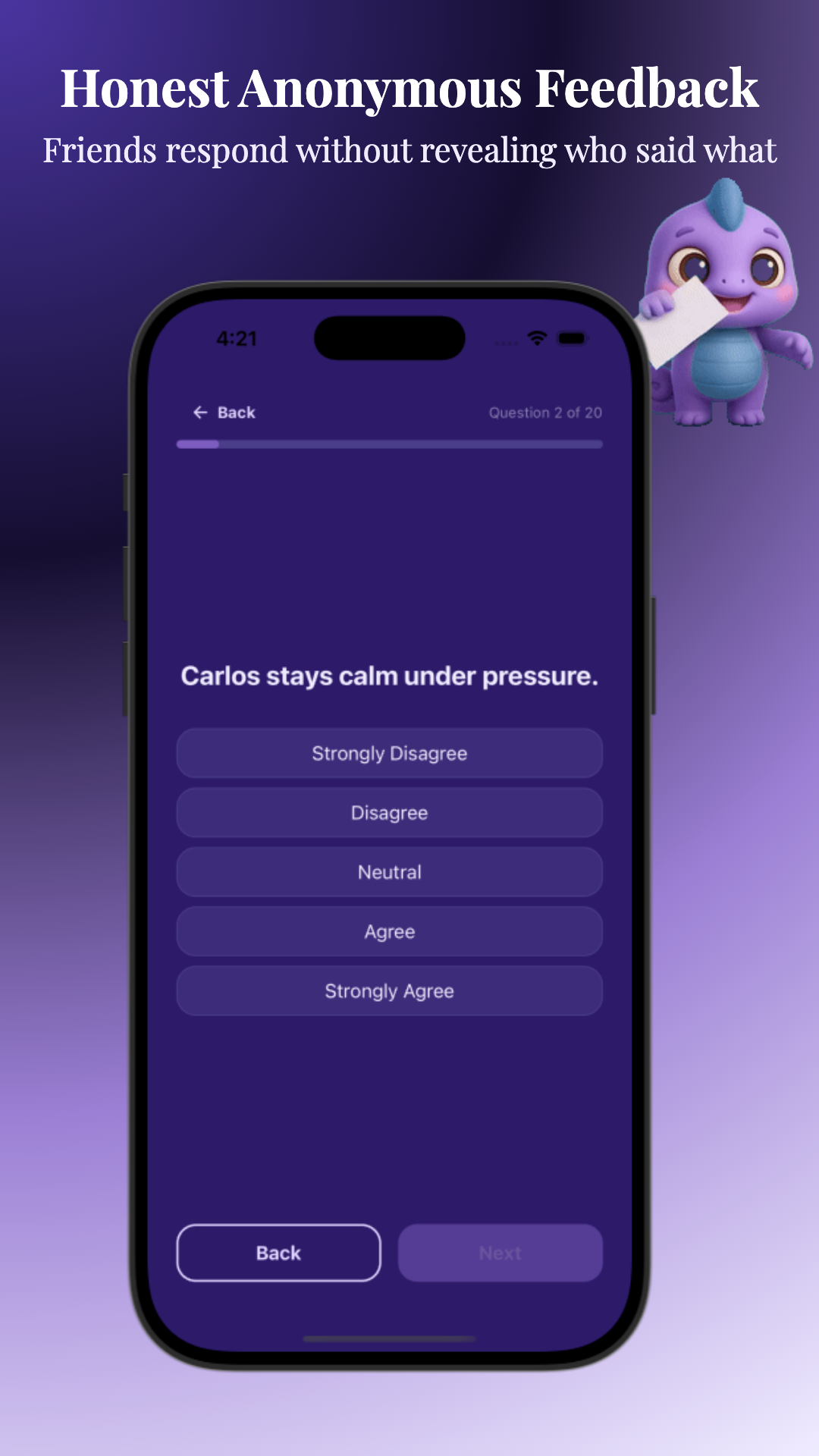
Sometimes, even with the best intentions, friends hesitate to be truthful in face-to-face conversations due to social pressure, fear of confrontation, or worry about damaging the relationship. Anonymous feedback platforms mitigate these barriers by allowing friends to express candid thoughts without fear of identification or repercussions.
Blindspot offers anonymous surveys where friends answer questions about you privately. The platform aggregates responses, revealing honest perceptions and highlighting patterns you might otherwise miss.
For example, you might discover that several friends perceive you as less approachable than you thought, a realization that can prompt meaningful personal growth. Or you may find affirming feedback that boosts your confidence.
To maximize the effectiveness of anonymous feedback:
- Invite a diverse group of friends from different contexts to provide input.
- Set clear expectations about the type of feedback you’re seeking.
- Be prepared to receive both positive and critical responses with an open mind.
- Follow up with friends if clarification is needed once anonymous results are revealed.
Section 4: Signs a Friendship is Genuine or Shallow
Consistency Between Words and Actions
One of the strongest indicators of genuine friendship is when a friend’s words align with their actions. For example, a friend who says they will support you during a difficult time and consistently checks in or offers help demonstrates authenticity. Conversely, shallow friendships are often marked by mixed signals, such as compliments that feel generic or insincere and avoidance of meaningful conversations.
To evaluate consistency, observe over several weeks or months. Occasional lapses are normal, but persistent discrepancies between expressed intentions and behaviors suggest superficiality.
Mutual Effort and Vulnerability
True friends invest time and emotional energy into the relationship. This includes sharing personal experiences, fears, and joys, and actively listening when you do the same. Vulnerability is a cornerstone of genuine connection. For instance, a friend who opens up about their struggles and invites you to do the same fosters trust and deepens bonds.
Mutual effort also means both parties initiate plans, maintain communication, and prioritize the relationship. If you find you are always the one reaching out or making sacrifices, the friendship may be imbalanced.
Public vs. Private Interactions
Public displays of friendship on social media, such as likes, comments, or tagged photos, don’t always reflect the real depth of connection. Genuine friends maintain meaningful private conversations and check-ins beyond social media interactions.
For example, a friend might rarely engage with your posts but consistently send supportive messages or make time for face-to-face meetings. Conversely, some may be active online but distant or unavailable in private communication.
Observing how friends behave in private chats versus public posts can reveal much about the friendship’s authenticity. Prioritize the quality of private interactions as a more reliable indicator of genuine friendship.
Section 5: The Role of Social Media and Algorithms in Ranking Friends
Algorithmic Friend Ranking and Its Limits
Social media platforms like Facebook, Instagram, and LinkedIn use complex algorithms to determine which friends’ content you see first, ostensibly based on your interaction frequency—likes, comments, messages, and tags.
However, this ranking is based on engagement metrics and not the quality or depth of your relationships. For example, a coworker you message daily about work tasks might appear higher in your feed than a lifelong friend you see monthly but share deep conversations with.
Understanding the limitations of algorithmic ranking helps prevent overvaluing social media interactions as proxies for real friendship. It’s essential to supplement this with offline engagement and direct communication.
Misreading Profile Views and Likes
It’s common to associate profile views, likes, or comments with interest or affection, but these can be misleading. Some users habitually like posts to maintain social etiquette, while others prefer private communication and avoid public engagement.
For example, a close friend might rarely comment but consistently reach out via direct message or phone call, indicating a different mode of connection. Conversely, frequent interactions from acquaintances might not translate into meaningful support or closeness.
Therefore, relying solely on these visible metrics risks misinterpreting the true nature of your social bonds.
How Social Media Shapes Perception
Social media often encourages curated and idealized portrayals of relationships and self-image. People tend to share highlights and positive moments, while struggles and conflicts remain hidden. This selective sharing can distort your understanding of what your friends really think and the health of your friendships.
For example, you might feel excluded if you don’t see posts about events you weren’t invited to, even if the exclusion wasn’t intentional. Alternatively, a friend’s constant posting of happy moments can create unrealistic comparisons or assumptions about their feelings towards you.
Balancing online impressions with real-world interactions and honest conversations is vital to maintain a grounded and accurate perspective of your social relationships.
Section 6: Interpreting Compliments, Criticism, and Silence
Reading Between the Lines
Compliments, while generally positive, can sometimes be polite or surface-level rather than deeply felt. To gauge sincerity, consider the context, frequency, and accompanying actions. For example, a compliment about your creativity that’s followed by offering collaboration opportunities is more meaningful than a one-off polite remark.
Criticism, especially when framed constructively, can be a valuable gift for growth. It’s important not to dismiss criticism outright but to evaluate its source, intent, and content. For example, if multiple friends kindly point out that you can come across as dismissive in conversations, this pattern is worth reflecting on.
Learning to separate constructive criticism from hurtful or unfounded comments is a nuanced skill that improves with practice and emotional maturity.
Understanding Silence and Distance
Silence or withdrawal from friends might indicate discomfort, disagreement, or changing feelings. However, it can also be due to external factors like stress, mental health struggles, or busy schedules. For instance, a friend who suddenly stops responding promptly might be overwhelmed rather than upset with you.
Avoid jumping to conclusions based solely on silence. Instead, seek clarification gently, such as “I noticed we haven’t talked much lately. Is everything okay?” This opens the door to honest dialogue without accusation.
Using Anonymous Feedback to Clarify Mixed Signals
Mixed messages—such as receiving compliments but sensing distance—can be confusing. Anonymous feedback tools help disentangle these mixed signals by collecting honest input without social pressure. When friends can share their thoughts candidly, patterns emerge, helping you understand whether perceived distance is real or imagined.
For example, anonymous responses might reveal that friends appreciate your humor but feel you sometimes dominate conversations, prompting you to adjust your behavior. Alternatively, they might affirm your positive traits, providing reassurance during times of uncertainty.
Regularly using platforms like Blindspot can maintain an ongoing feedback loop, strengthening relationships over time.
Conclusion
Discovering what your friends really think of you is a challenging but rewarding journey that requires courage, openness, and the right tools. Psychological biases, social dynamics, and the influence of social media all complicate self-awareness and relationship understanding.
By seeking honest feedback—especially through anonymous tools like Blindspot—you can uncover hidden perceptions, recognize genuine friendships, and grow into a more self-aware and connected person. Embrace openness, ask thoughtful questions, and be ready to listen deeply.
This approach not only reveals your true social image but also empowers you to strengthen your bonds and personal development. Over time, applying these insights fosters deeper empathy, improved communication, and more fulfilling relationships.
FAQ
Q: Can you really know what your friends think of you?
A: While it’s difficult to know fully due to social masks and biases, you can gain accurate insights through honest, direct, or anonymous feedback methods that encourage openness. Using structured tools reduces guesswork and reveals patterns beyond casual impressions.
Q: How do you ask friends what they honestly think of you?
A: Create a safe space by explaining your intention clearly, ask specific and open-ended questions, and consider using anonymous feedback tools to reduce social pressure. Express gratitude and model vulnerability to encourage candidness.
Q: What does it mean if a friend says nice things but acts differently?
A: This inconsistency may indicate a shallow or conflicted friendship where words don’t match feelings or actions. Observing patterns over time, including private interactions and whether they follow through on promises, can clarify their true sentiments.
Q: Does Facebook or Instagram show who your real friends are?
A: Not necessarily. Social media algorithms rank friends by interaction frequency, which doesn’t always reflect relationship depth or authenticity. Offline behaviors and mutual effort are better indicators of genuine friendship.
Q: How can you tell if a friend is genuine?
A: Genuine friends demonstrate consistent behavior, mutual effort, vulnerability, and support both publicly and privately. They align words with actions, maintain communication during good and bad times, and respect boundaries.
Q: What are signs that people see you differently than you see yourself?
A: Signs include receiving unexpected feedback, noticing discrepancies between your self-view and others’ reactions, or recognizing blind spots revealed through tools like the Johari Window or anonymous feedback apps. Being open to feedback and reflecting on it helps bridge these gaps.