What Do My Friends Really Think of Me? (And How to Actually Find Out)

There's a particular kind of curiosity that hits at 1 a.m. or after a weird interaction at brunch:
What do my friends actually think of me?
Not the polite version. Not what they say to your face. The real version — the one they'd tell each other if you weren't in the group chat.
It's a question almost everyone has asked themselves, and almost no one has gotten an honest answer to. There's a reason for that, and there's also a way around it.
Why this question is harder than it looks
We assume our friends see us roughly the way we see ourselves. Decades of research says: not quite.
In personality psychology, this is sometimes called the self-other knowledge asymmetry — the gap between what you know about yourself from the inside and what other people pick up from the outside. Your inner monologue tells you you're shy, considerate, and bad at decisions. Your friends watch your behavior and conclude you're warm, a little stubborn, and weirdly good in a crisis.
Both of those views are real. Neither is the whole picture.
There are a few specific reasons the gap exists:
- You can't see your own face. Or your tone. Or what your body does when you're stressed. Your friends can.
- You judge yourself by intentions; others judge you by impact. You meant the joke kindly. They felt the sting.
- You weight your worst moments more heavily. They mostly remember the time you showed up when no one else did.
- Politeness wipes the data. When you ask, "Be honest — am I annoying?" your friends are wired to say no, even if the honest answer is "sometimes, in a fun way."
That last one is the killer. Polite friends are great for life and useless for self-knowledge.
What the research actually says
A few patterns show up consistently in self-perception research:
- People overestimate their own decisiveness, intelligence, and humor.
- People underestimate their own empathy, leadership, and likability.
- The traits you're most insecure about are usually not the ones others notice.
- Your "biggest flaw" in your own head is often invisible to the people around you.
Read that list again, because it matters: the things you're most worried about are usually not what your friends are seeing. The things they admire most about you are often things you don't even register as strengths.
This is why "what do my friends think of me" almost never has the answer you're bracing for.
Why you can't just ask
You can ask. The answer just won't be useful.
Try it. Text three friends right now: "Be totally honest — what's something I do that's annoying?"
Watch what comes back:
- "Nothing! You're great 🥰"
- "Hmm I can't think of anything tbh"
- "You sometimes don't text back fast lol"
This isn't because your friends are lying. It's because:
- Saying something critical to your face has a real social cost for them.
- They have to come up with the answer in 30 seconds, with no structure.
- They don't want the conversation that would follow.
- Most people are bad at giving feedback even when they want to.
To get useful information, you have to remove all four of those frictions: the social cost (anonymity), the time pressure (structure), the conversational fallout (one-way feedback), and the lack of practice (specific questions).
The four ways to actually find out
Okay — assuming you genuinely want to know, and not just looking for compliments. Here are the methods that actually work, ranked roughly by effort.
1. Structured private questions to one trusted friend
Pick the friend who is least afraid of you. Tell them: "I'm trying to get a more honest sense of how I come across. Can you answer five specific questions for me, and I promise not to be weird about it?"
Then ask things like:
- "If you had to describe my communication style in one sentence, what would it be?"
- "What's something I do that I probably don't realize I do?"
- "When am I at my best around other people?"
- "When do I shut down or get harder to be around?"
- "What's a strength of mine I might be underestimating?"
This works because the questions are specific. "Am I annoying?" produces nothing. "What do I do that I probably don't realize?" produces real answers.
2. The 360-feedback approach (work edition)
If you're in a job that does 360 reviews, lean in. They're awkward, they're imperfect, and they're often the most honest signal you'll ever get about how you operate around other people. The format works because feedback is anonymous, aggregated across multiple people, and tied to specific behaviors instead of vibes.
The downside is that work-360s only tell you about your work persona, which is usually a curated version of you. The "you" your friends know is a different dataset.
3. Structured friend-feedback apps
A new generation of apps has been built specifically around this problem, and the format is different from anything you've used before. Instead of an open box where anyone can say anything, you and your friends both answer the same structured questions — and the app shows you the gaps.
The ones worth using share a few traits:
- Specific, research-backed questions (not "send me messages")
- A closed group of people you actually invite — your friends, your partner, your team — not strangers
- Aggregated answers, so you see patterns instead of single comments
- A direct comparison between how you rated yourself and how your friends rated you, side by side
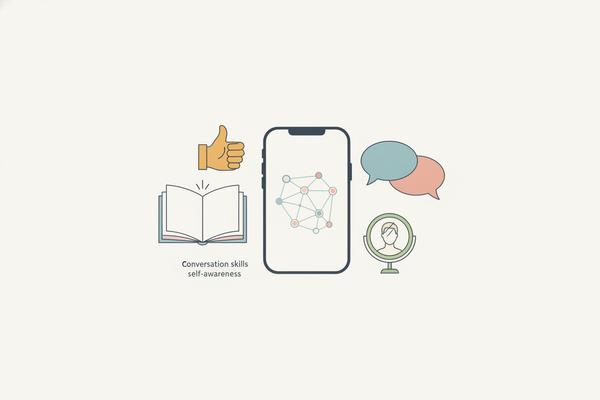
That's the category Blindspot lives in. Full disclosure: this post is from the team that builds it. You answer honest questions about yourself across categories like communication, emotional intelligence, leadership, empathy, decisiveness, reliability, and creativity. You invite a small group of friends through a private code. They answer the same questions about you. The app then shows you exactly where your self-perception matches their view and where it doesn't — with radar charts, gap analysis, and AI-generated insights.
You can grab it here if you want to skip the rest of this post and just go see your blind spots:
- iOS: Download on App Store
- Android: Get it on Google Play
- Web: whatdomyfriendsthinkofme.com
4. Just pay attention
Less satisfying, but real: most of what your friends think of you, they're already showing you. Who do they call when they're in trouble? Who gets invited to plan things vs. just attend them? Who do they tell their secrets to? Patterns are data.
Who to actually ask (this matters more than the method)
The biggest mistake people make running any version of this exercise is picking the wrong group of people to ask.
There are three common traps:
Trap 1: Asking only your closest friends.
Your best friends will give you the most generous picture of yourself, not the most accurate one. They've been on your team for years. They've watched you at your best. They've also slowly acclimated to your worst habits and stopped noticing them. If your sample is "three people who would set themselves on fire for you," the picture you'll get back is going to be very flattering and not very useful.
Trap 2: Asking only people you've impressed.
The coworker you're trying to mentor under, the friend-of-a-friend you're hoping to date, the new gym group you joined three months ago — these people will give you a "first impressions" version of you, which is just your highlight reel. Worth knowing, but not the same as knowing what people who've seen you on a bad Tuesday think.
Trap 3: Asking only one context.
Your work persona, your family persona, your group-chat persona, and your one-on-one-late-at-night persona are not the same person. If your entire sample is from one context, you'll get a very confident answer to "how does my work self come across" while completely missing what's happening in the other rooms.
The ideal mix is small but diverse: one close friend, one family member, one person who knows you from work or school, and one person who's seen you in a less curated context (a partner, a roommate, a group chat where you're not on your best behavior). Four people from four contexts is more useful than ten people from one context.
Pick honest people, not nice people. Honest people will give you a real signal. Nice people will give you what they think you can handle, which is usually less than the truth.
What you'll probably find out
When people actually run a structured self-vs-friend comparison — through any of the methods above — a few patterns repeat across almost everyone.
You'll probably underestimate:
- How much your friends rely on you emotionally
- Your sense of humor
- Your loyalty (people who think they're flaky are often considered very dependable)
- Your leadership in groups (you set more of the tone than you realize)
You'll probably overestimate:
- How much you talk about yourself
- How decisive you come across (most "decisive" self-views look like "fast" or "blunt" from the outside)
- How well you hide your moods
You'll probably be surprised by:
- One specific strength you've never claimed
- One quirk everyone has noticed that you thought was invisible
- A category you don't think about that turns out to be a defining feature of how people experience you
The surprise is the point. If you ran the exercise and learned nothing, your friends were too polite or your questions were too vague.
How to handle results that sting
Honest feedback occasionally lands hard. Here's how to take it without spiraling:
Sit with it for 24 hours before reacting. First-hour reactions to feedback are almost always wrong. You'll either reject something true or accept something false.
Look for the pattern, not the data point. If one friend says you interrupt, that's a data point. If three say it, that's a pattern. Patterns are real. Single comments are noise.
Separate the signal from the delivery. Sometimes feedback is poorly worded but pointing at something real. Sometimes it's well-worded and pointing at the friend's issue, not yours. Both happen.
Notice what surprised you most. The biggest surprises are usually your biggest blind spots. They're worth more than the things that confirmed what you already knew.
Remember most of it is going to be good news. Genuinely. The blind-spot version of you that your friends see is usually a more generous portrait than the one in your head.
The point isn't a verdict — it's a map
The reason the question "what do my friends think of me" lives rent-free in people's brains is that we're treating it like a verdict. Pass or fail. Liked or not.
That's not what's actually on offer. What's on offer is a map.
A map of where the version of you in your head matches the version of you out in the world, and where it doesn't. The places where it matches are your most trustworthy self-knowledge. The places where it doesn't are where most of your growth lives.
You don't need to fix everything you find. You just need to see it. Once you can see it, you have a choice. Until you can see it, you're just guessing — and the gap quietly costs you.
Try it
If you want a structured way to actually find this out — anonymous on the friends' side, framework-based, and showing you specifically where your self-view diverges from theirs — Blindspot was built for this exact question.
- iOS: Download on App Store
- Android: Get it on Google Play
The honest answer to "what do my friends think of me" is almost never the one you're bracing for. It's usually better. Worth knowing.