Emotional Intelligence Test Free: A Comprehensive Self-Assessment Guide
Discover free tools to measure emotional intelligence, compare EQ vs IQ, and identify signs of high emotional intelligence. Start your self-assessment today.

Estimated reading time: 12 minutes
Key Takeaways
- Emotional intelligence (EI) influences leadership and well-being more than IQ.
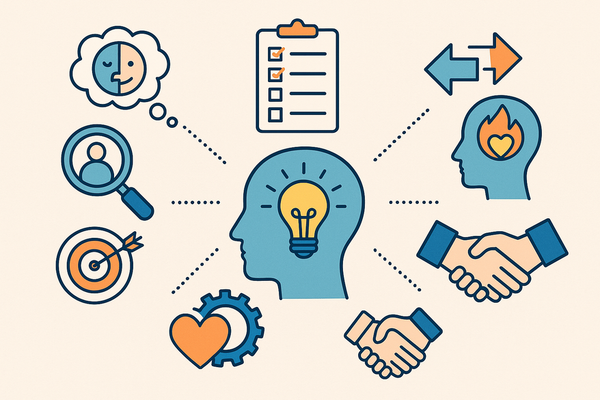
- EI comprises self-awareness, self-regulation, motivation, empathy, and social skills.
- Free online EQ tests offer quick insights but vary in scientific validity.
- Use self-reflection questions to gauge your emotional strengths and triggers.
- Follow a structured approach—choose a reliable test, prepare, and review feedback.
Table of Contents
- Understanding Emotional Intelligence
- Why EI Matters in Work and Life
- Exploring the “Emotional Intelligence Test Free” Option
- Self-Assessment: “Am I Emotionally Intelligent?”
- In-Depth Look at Emotional Awareness Assessment
- Comparing Assessments – “EQ vs IQ Test”
- Identifying “Signs of High Emotional Intelligence”
- Practical Framework for Taking an “EQ Test Online”
- FAQ
Understanding Emotional Intelligence
Emotional intelligence is the measurable ability to monitor your own emotions and those of others, to distinguish among them, and to use this information to guide thinking and behavior. This concept originated with Mayer & Salovey and was later popularized by Daniel Goleman.
Core Components of EI:
- Self-Awareness – recognizing your own emotions, strengths, and weaknesses
- A manager uses self-awareness to notice frustration before it shows in their tone.
- Self-Regulation – controlling or redirecting disruptive impulses
- A team lead stays calm during a heated discussion by pausing to breathe.
- Motivation – passion for work beyond external rewards
- An engineer works late because they love solving puzzles, not just for a bonus.
- Empathy – understanding others’ emotional makeup
- A customer service rep senses a caller’s stress and speaks in a gentle tone.
- Social Skills – building relationships and networks
- A salesperson builds trust by listening more than they talk.
To explore how blind spots affect your self-awareness in practice, check out our modern guide to the Johari Window model and its applications.
Why EI Matters in Work and Life
- Better Communication: Emotionally aware people tune into others’ needs.
- Smarter Decisions: They factor feelings into choices, avoiding rash calls.
- Stronger Teams: High EI helps leaders and peers resolve conflicts fast.
- Improved Well-Being: Managing feelings cuts stress and burnout.
Exploring the “Emotional Intelligence Test Free” Option
Benefits of Free Online EQ Testing
- Accessibility: Take a test anytime, anywhere, on any device.
- Immediate Insights: See your scores right away to plan growth.
- Practical Utility: Learn tips on managing real-life emotions.
- Enhanced Decision-Making: Use test feedback to weigh feelings in choices.
- Relationship Improvement: Practice empathy exercises from results.
Limitations & Considerations
- Validation Concerns: Free tests may lack peer-reviewed accuracy.
- Self-Report Bias: Answers can reflect how you wish to be, not reality.
- Limited Depth: Short tests cover basics but miss complex traits.
Finding Reliable “EQ Test Online” Options
Criteria for Choosing:
- Scientific Foundation: Based on Bar-On, Goleman, or Mayer-Salovey.
- Transparency: Clear on what is measured.
- Clarity of Instructions: Easy to follow for honest answers.
- Contextual Feedback: Offers tips, not just scores.
Top 3 Free Reputable Tests:
- 123test (Bar-On’s theory) – 123test
- ActionableSelf (Goleman-based) – ActionableSelf
- Positive Psychology’s free version – Positive Psychology
Self-Assessment: “Am I Emotionally Intelligent?”
Getting started with am I emotionally intelligent requires honest reflection. Use these questions to see where you stand:
Self-Awareness
- Can I identify what I’m feeling in real time?
- Do I know my biggest emotional triggers?
- Can I name my top strengths and weaknesses?
Self-Regulation
- Do I pause before reacting when upset?
- Can I calm myself after a bad day?
- Do I set rules for how I speak under stress?
Empathy
- Can I accurately read others’ emotional cues?
- Do I ask how people feel without judging?
- Can I sense mood in a group before they speak?
Social Skills
- Do people find me easy to collaborate with?
- Can I steer a team toward compromise?
- Do I follow through on commitments?
Motivation
- Am I driven by purpose rather than rewards?
- Do I bounce back from setbacks?
- Do I set goals that excite me?
Answering these flags areas for a formal test. Combine reflection with an emotional intelligence test free and feedback from friends or co-workers for best results. For methods to gather honest, anonymous feedback from peers, see our guide.
In-Depth Look at Emotional Awareness Assessment
An emotional awareness assessment is a specialized evaluation measuring your ability to recognize and label emotions in yourself and others.
Four Measurement Dimensions:
- Emotion Recognition – spotting basic emotions in faces or voices
- Emotional Labeling – naming subtle emotion shades like “frustration” vs “anger”
- Self-Awareness Triggers – knowing what events spark your mood shifts
- Social Awareness Context – reading group feelings and atmospheres
Typical Format:
- 40–100 statements or scenarios
- Rate how much each fits your reaction
- Must answer based on real behavior, not ideal self
Scoring Criteria:
- Accuracy: Do your labels match real emotion?
- Consistency: Are your answers steady across similar items?
- Adaptability: Can you shift views when context changes?
- Insight: Do you explain why you felt that way?
Research Basis: Designs use validated scales from Bar-On or Mayer-Salovey to ensure tests are solid.
Comparing Assessments – “EQ vs IQ Test”
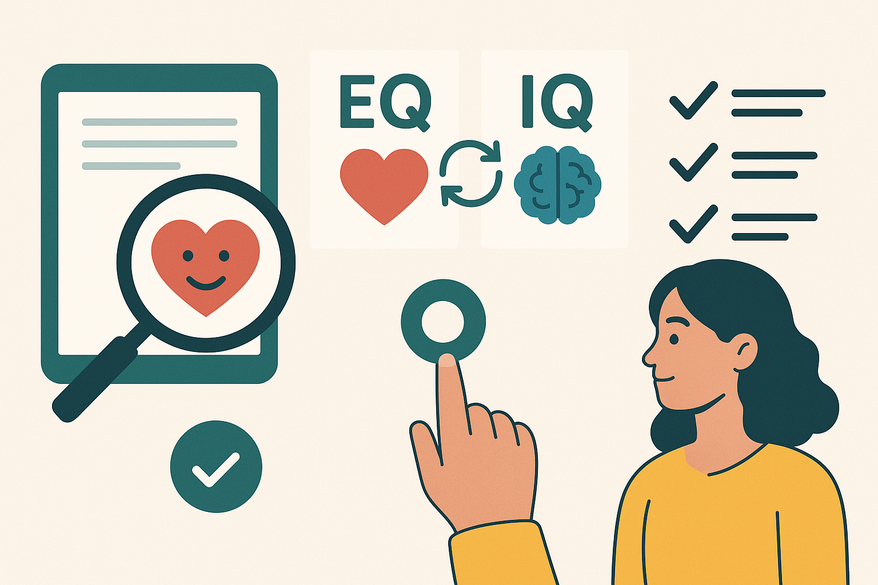
An IQ test measures cognitive reasoning tasks, while an EQ test looks at emotional and social competencies.
Comparison Overview:
- What It Measures: Emotional/social competencies vs cognitive abilities
- Method: Self-report or ability-based vs standardized puzzles and questions
- Malleability: Developable vs more stable, partly genetic
- Professional Impact: EQ aids leadership and teamwork vs IQ helps technical roles
- Validation: Many free options vs rigorous scientific standards
Why EQ Assessments Are Valued:
- Predictive Power: They forecast leadership success.
- Development Potential: You can boost EQ skills with practice.
- Holistic Performance: Teamwork, creativity, and adaptability grow with EQ.
- Culture Building: EQ-savvy staff improve workplace mood.
- Conflict Resolution: They ease and solve disputes faster.
Common Misconceptions About EQ vs IQ Test:
- Misconception: “EQ is just ‘soft skills’.” Reality: EQ is a measurable ability with real brain and behavior data.
- Misconception: “High IQ means high EQ.” Reality: They are separate; bright people can lack emotional awareness.
- Misconception: “You either have EQ or you don’t.” Reality: Emotional intelligence can be learned at any age.
- Misconception: “EQ tests aren’t scientific.” Reality: Validated EQ tests meet strong research standards.
Identifying “Signs of High Emotional Intelligence”
- Effective Stress Management
- Stay calm under pressure
- Use stress signals to adjust plans
- Bounce back quickly from setbacks
- Genuine Empathy
- Listen without judgment
- Show compassion and understanding
- Remember and act on others’ feelings
- Adaptability and Flexibility
- Pivot when new information appears
- Embrace uncertainty as a chance to learn
- Modify tactics when needed
- Strong Relationship Building
- Connect through active listening
- Resolve conflicts with fairness
- Keep promises they make
- Self-Awareness and Accountability
- Know your limits and strengths
- Own mistakes without blame
- Seek feedback to improve
- Intrinsic Motivation
- Work for purpose, not just pay
- Tackle challenges aligned with values
- Show resilience in hard tasks
Practical Framework for Taking an “EQ Test Online”
- Choose a Reputable Platform – 123test, ActionableSelf, Positive Psychology
- Prepare Your Environment – Quiet room, no phone, low stress
- Be Authentic – Answer as you truly are, not as you want to be
- Allocate Time – Set aside 10–15 minutes, no rushing
- Review Results in Detail – Read explanations for each dimension
- Identify Patterns – Note scores, strengths vs growth areas
Interpreting Your EQ Score:
- Growth Opportunity (0–40): Big room to grow
- Effective (41–70): Solid base, refine skills
- High Performer (71–100): Strong EQ, a role model
Conclusion & Call-to-Action
Emotional intelligence is a skill you can measure and build. Starting with an emotional intelligence test free can kick-start your journey to greater self-awareness and professional success.
For deeper self-awareness and to uncover how friends perceive your emotional strengths and blind spots, use the Blindspot App.
Next Steps:
- Take a free EQ test online from the list above
- Reflect using the “am I emotionally intelligent” questions
- Choose one EI component to improve first
- Make an action plan with clear behaviors
- Seek expert coaching if you want deeper support
- For structured peer insights beyond standard tests
FAQ
- What is emotional intelligence?
It’s the ability to recognize, understand, and manage your own emotions and those of others. - Are free EQ tests accurate?
They offer quick insights but may lack peer-reviewed validation; use them as a starting point. - How can I improve my EI?
Practice self-awareness, seek feedback, and apply strategies from your test results. - What’s the difference between EQ and IQ?
IQ measures cognitive ability; EQ measures emotional and social skills—both matter in different contexts. - Can I learn EI at any age?
Yes—emotional intelligence is developable through intentional practice and reflection.