Discover Your Conflict Resolution Style Quiz: Uncover How You Handle Disagreements
Take the conflict resolution style quiz to understand how you handle disagreements, explore Thomas-Kilmann modes, and discover if you're conflict avoidant.

Estimated reading time: 8 minutes
Key Takeaways
- Identify your natural patterns in disputes using a conflict resolution style quiz.
- Understand the five Thomas-Kilmann modes to adapt your approach.
- Combine multiple assessments for a 360° view of your conflict behaviors.
- Apply style-specific strategies to handle disagreements confidently.
- Gather external insights with tools like the Blindspot App.
Table of Contents
- Defining Conflict Resolution Styles
- Overview of the Conflict Resolution Style Quiz
- Exploring Thomas-Kilmann Conflict Modes
- Self-Evaluation: How Do I Handle Conflict?
- Diving Deeper: Personality Aspects
- Integrating the Quizzes for Comprehensive Self-Assessment
- Practical Tips and Takeaways
- Conclusion
Defining Conflict Resolution Styles
Conflict resolution is the process of addressing disputes amicably to minimize stress and lost productivity. It builds bridges instead of burning them.
Why it matters:
- At work—to boost teamwork and reduce absenteeism.
- In families—to resolve clashing values or goals.
- In friendships—to navigate shifting power dynamics.
Common conflict behaviors:
- Avoidance—sidestepping issues and staying silent.
- Reactivity—emotional escalation and heated exchanges.
- Peacemaking—seeking harmony and quick resolution.
No single style is “right.” Each has strengths and weaknesses. Overreliance on avoidance or aggression can fracture bonds over time.
Sources:
https://www.coursera.org/learn/conflict-resolution-skills
https://www.waldenu.edu/blog/what-is-conflict-resolution
https://www.pon.harvard.edu
Overview of the Conflict Resolution Style Quiz
A conflict resolution style quiz is a scenario-based self-assessment that measures your default responses to disputes.
Benefits:
- Self-awareness—spot your go-to behaviors.
- Strategy selection—match style to situation.
- Improved outcomes—choose collaboration over competition for high-stakes issues.
Typical quiz outputs:
- Conflict avoidant: you shy away from disagreements.
- Reactive/assertive: you confront head-on.
- Peacemaker: you mediate and build consensus.
For example, Study.com outlines three approaches: third-party intervention, unilateral decisions, or joint problem-solving. Knowing your style helps you pick the best tactic.
Sources:
https://www.coursera.org/learn/conflict-resolution-skills
https://study.com/academy/lesson/conflict-management-definition-examples.html
Exploring Thomas-Kilmann Conflict Modes
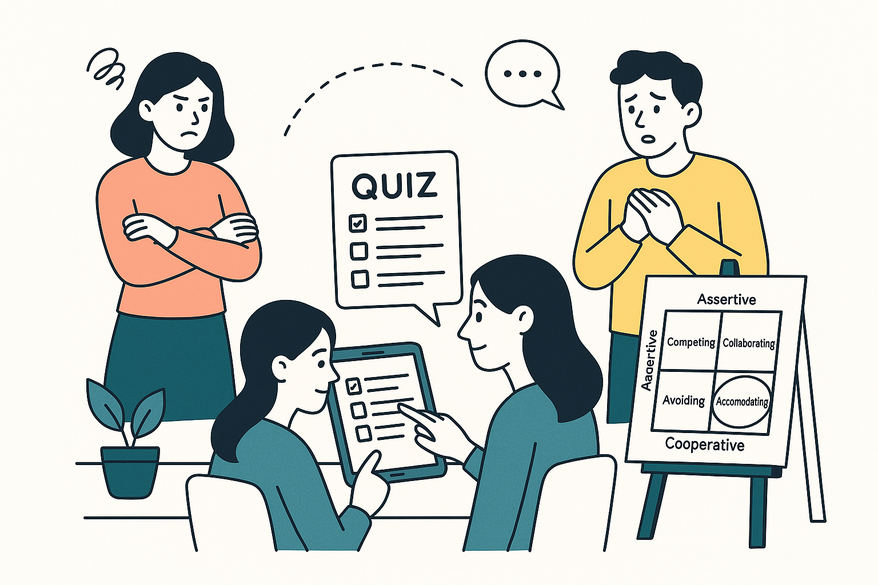
The Thomas-Kilmann Conflict Mode Instrument (TKI) is a gold-standard framework using two axes: assertiveness (focus on self) and cooperativeness (focus on others).
- Competing
– High assertiveness, low cooperation.
– Pro: Fast decisions in critical situations.
– Con: Can damage relationships.
– When to use: Emergency calls, tight deadlines. - Avoiding
– Low assertiveness, low cooperation.
– Pro: Good for trivial matters.
– Con: Risks unresolved issues.
– When to use: Minor annoyances. - Accommodating
– Low assertiveness, high cooperation.
– Pro: Builds goodwill.
– Con: Can breed resentment.
– When to use: Preserving relationships. - Collaborating
– High assertiveness, high cooperation.
– Pro: Win-win, creative solutions.
– Con: Time-consuming.
– When to use: Complex, long-term issues. - Compromising
– Moderate assertiveness, moderate cooperation.
– Pro: Quick, fair trade-offs.
– Con: May leave both sides partly dissatisfied.
– When to use: Tight timelines, intermediate stakes.
A conflict resolution style quiz often maps your results to these modes so you can see where you fall and how to shift when needed.
Sources:
https://utsystem.edu/sites/default/files/sites/strategic-communications/Conducting-Effective-Conversations.pdf
https://www.northcentralcollege.edu/resources/conflict-resolution
Self-Evaluation: How Do I Handle Conflict?
“How do I handle conflict?”—do you confront directly or withdraw? “Am I conflict avoidant?”—signs include changing the subject or anxiety at the first hint of disagreement.
Reflective questions:
- Do I focus on goals or relationships in a dispute?
- How do I feel when someone challenges me—angry, scared, or calm?
- Do I offer solutions or let others decide?
Self-evaluation tips:
- Recall recent disputes—note if you prioritized outcomes or harmony.
- Track patterns—did you avoid, assert, or collaborate based on issue severity?
- Journal emotional reactions—frustration (reactive) vs. empathy (peacemaker).
- Practice active listening—pause, ask questions, and gather perspectives before responding.
To explore your blind spots further, see our guide on the Johari Window Test.
Sources:
https://mailchimp.com/resources/what-is-conflict-management/
https://www.coursera.org/learn/conflict-resolution-skills
Diving Deeper: Personality Aspects
A peacemaker personality test measures traits like empathy, patience, and diplomacy. People strong in these areas align with accommodating or collaborating modes but may edge toward conflict avoidant when stakes feel high.
Peacemaker approach:
– Strengths: De-escalation, relationship focus.
– Challenges: Hesitating on tough calls, underplaying needs.
Compare fight-or-flight responses:
- Fight = reactive/competing style—ready to argue.
- Flight = avoiding style—stepping back.
A fight or flight conflict quiz reveals if you’re wired to battle or retreat under stress.
Sources:
https://www.pollackpeacebuilding.upenn.edu
https://study.com/academy/lesson/conflict-management-definition-examples.html
Integrating the Quizzes for Comprehensive Self-Assessment
Combine four assessments for a 360° view:
- Take the conflict resolution style quiz → identifies your default mode.
- Review Thomas-Kilmann results → maps you to one of five modes.
- Compare with the peacemaker personality test → confirms empathy/cooperation levels.
- Use the fight or flight conflict quiz → reveals stress-response tendencies.
Example scenario for an “avoidant” profile:
- Style quiz: Avoidance.
- TKI: Avoiding mode.
- Personality test: High empathy (peacemaker).
- Fight/flight quiz: Flight response.
This holistic insight shows you prefer stepping back to dodge stress, yet you value harmony. Learn to push gently into collaboration when needed. For honest outside perspectives, try our anonymous feedback from friends.
Sources:
https://www.waldenu.edu/blog/what-is-conflict-resolution
Practical Tips and Takeaways
Style-specific strategies (PON Harvard best practices):
- Avoidant/Conflict Avoidant:
• Start with low-stakes chats—build confidence.
• Schedule regular check-ins to air small issues before they grow. - Competing/Reactive:
• Use “I” statements—express needs without blaming.
• Pause, breathe, and consider others’ views before speaking. - Accommodating/Peacemaker:
• Set clear boundaries—practice asking for what you need.
• Balance giving with requesting to prevent burnout. - Collaborating:
• Lead joint brainstorming sessions.
• Seek win-win solutions with shared goals. - Compromising:
• Agree on fair trade-offs—ensure both sides get value.
• Use when time or resources are limited.
Pair your strategies with a communication style quiz to refine dialogue skills.
General advice:
- Set ground rules (respectful tone, no interruptions).
- Listen actively—summarize what you hear to confirm understanding.
- Weigh long-term consequences over quick wins.
- Role-play or peer-feedback to practice new styles.
Sources:
https://www.pon.harvard.edu
https://www.northcentralcollege.edu/resources/conflict-resolution
Conclusion
Understanding your conflict resolution style transforms tense moments into growth opportunities. Start by taking a conflict resolution style quiz and exploring the Thomas-Kilmann assessment. Then, try a peacemaker personality test and a fight or flight conflict quiz. Reflect: how do I handle conflict? Am I conflict avoidant? These insights guide you to adapt—shifting from avoidance to collaboration or from aggression to empathy. Embrace self-discovery and turn every disagreement into a step forward.
FAQ
Q: What is a conflict resolution style quiz?
A: It’s a scenario-based assessment that uncovers your default approach to disputes.
Q: What are the five Thomas-Kilmann conflict modes?
A: Competing, Avoiding, Accommodating, Collaborating, and Compromising.
Q: How can I use these quizzes for self-awareness?
A: Combine your results, reflect on patterns, and practice targeted strategies to improve outcomes.
Q: What if I’m conflict avoidant?
A: Start with low-stakes discussions, schedule check-ins, and gradually engage in more challenging conversations.
Q: How do I get feedback from others?
A: Use tools like the Blindspot App for real-time perspectives.